×
Dans

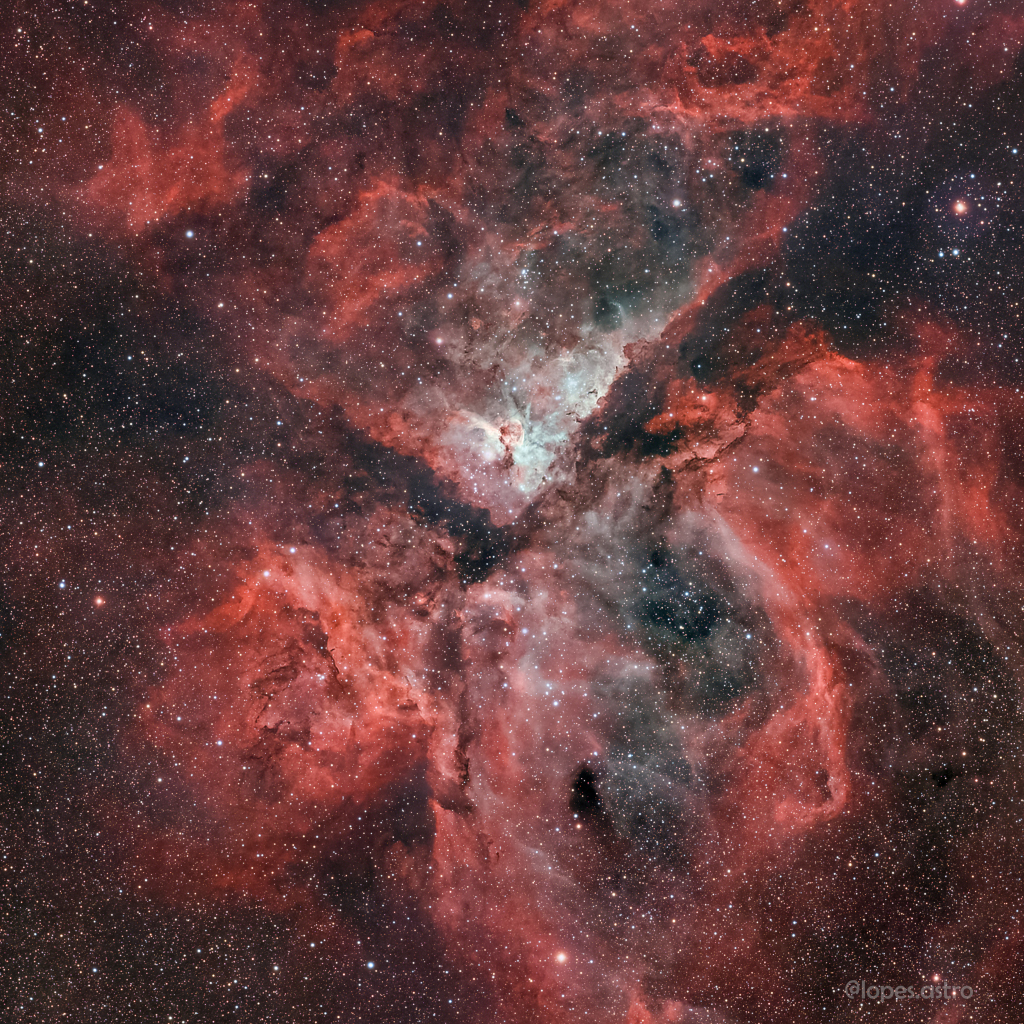
A jewel of the southern sky, the Great Carina Nebula is more modestly known as NGC 3372. One of our Galaxy’s largest star forming regions, it spans over 300 light-years. Like the smaller, more northerly Great Orion Nebula, the Carina Nebula is easily visible to the unaided eye. But at a distance of 7,500 light-years it lies some 5 times farther away. This stunning telescopic view reveals remarkable details of the region’s glowing filaments of interstellar gas and obscuring cosmic dust clouds. The Carina Nebula is home to young, extremely massive stars, including the still enigmatic variable Eta Carinae, a star with well over 100 times the mass of the Sun. Eta Carinae is the bright star above the central dark notch in this field and left of the dusty Keyhole Nebula (NGC 3324).

2024-04-19

Auteur/autrice

pelerinmarc@gmail.com

Publications similaires

Dans

Three Sky Arches over Snowy Alps

Pourquoi y a-t-il trois arches dans le ciel au lieu de deux ? Le mois dernier, après avoir été déposé par hélicoptère...

Lire la suite
Dans

Comet R3 PanSTARRS over a Himalayan Valley

La meilleure façon d’observer la longue queue de la comète R3 PanSTARRS est avec un appareil photo. Cette semaine, la comète récemment...

Lire la suite
Dans

Eye on the Milky Way

Avez-vous déjà eu des étoiles dans les yeux ? Il semble que l’œil de gauche en ait, et de plus, il semble...

Lire la suite
Dans

PanSTARRS and Planets

Près de l’horizon est avant le lever du soleil, la comète C/2025 R3 PanSTARRS devient plus brillante. Facilement visible aux jumelles et...

Lire la suite
Dans

M82: Starburst Galaxy with a Superwind

M82 est une galaxie à sursaut de formation d’étoiles, dotée d’un « supervent ». En effet, par le biais d’explosions de supernovae et de...

Lire la suite
Dans

South Celestial Tree

Si vous vivez dans l’hémisphère nord, vous avez peut-être appris à repérer l’étoile Polaire, Polaris, dans le ciel nocturne. Elle peut être...

Lire la suite