×
Dans

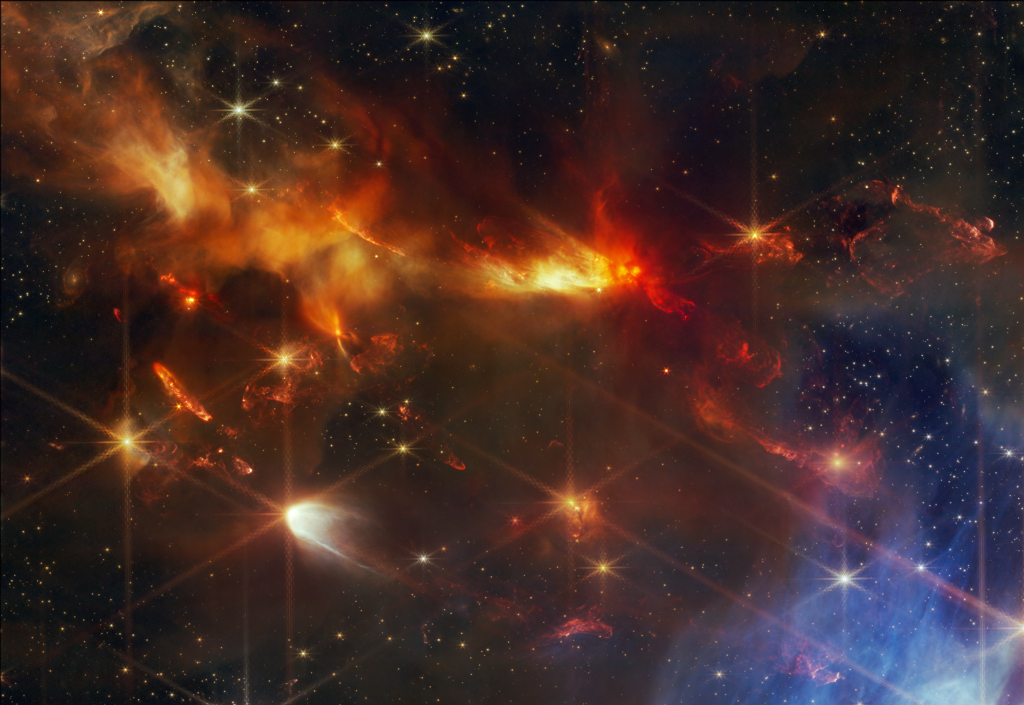
Jets of material blasting from newborn stars, are captured in this James Webb Space Telescope close-up of the Serpens Nebula. The powerful protostellar outflows are bipolar, twin jets spewing in opposite directions. Their directions are perpendicular to accretion disks formed around the spinning, collapsing stellar infants. In the NIRcam image, the reddish color represents emission from molecular hydrogen and carbon monoxide produced as the jets collide with the surrounding gas and dust. The sharp image shows for the first time that individual outflows detected in the Serpens Nebula are generally aligned along the same direction. That result was expected, but has only now come into clear view with Webb’s detailed exploration of the active young star-forming region. Brighter foreground stars exhibit Webb’s characteristic diffraction spikes. At the Serpens Nebula’s estimated distance of 1,300 light-years, this cosmic close-up frame is about 1 light-year across.

Auteur/autrice

marcpm@gmail.com

Publications similaires

Dans

NGC 188: Old Cluster in the New General Catalogue

Le New General Catalogue of star clusters and nebulae n’est en réalité pas si nouveau. Il a été publié en 1888, fruit...

Lire la suite
Dans

NGC 188: Old Cluster in the New General Catalogue

Le « New General Catalog of Star Clusters and Nebulae » n’est en réalité pas si nouveau. Il a été publié en 1888, un...

Lire la suite
Dans

The Conjunction of Comet R3 PanSTARRS and the Orion Nebula

L’image composite d’aujourd’hui présente quelque chose de vieux, quelque chose de neuf, quelque chose d’emprunté et quelque chose de bleu ! La...

Lire la suite
Dans

Moon Setting Behind Teide Volcano

Ces personnes ne sont pas en danger. Ce qui descend de la gauche n’est que la Lune, très loin à l’horizon. La...

Lire la suite
Dans

Comet R3 PanSTARRS and Orion

Orion n’avait jamais eu une épée pareille. Alors que la comète C/2025 R3 (PanSTARRS) quitte le système solaire interne, elle offre un...

Lire la suite
Dans

Messier Craters in Stereo

De nombreuses nébuleuses brillantes et amas d’étoiles dans le ciel de la Terre sont associés au nom de l’astronome Charles Messier, d’après...

Lire la suite