×
Dans

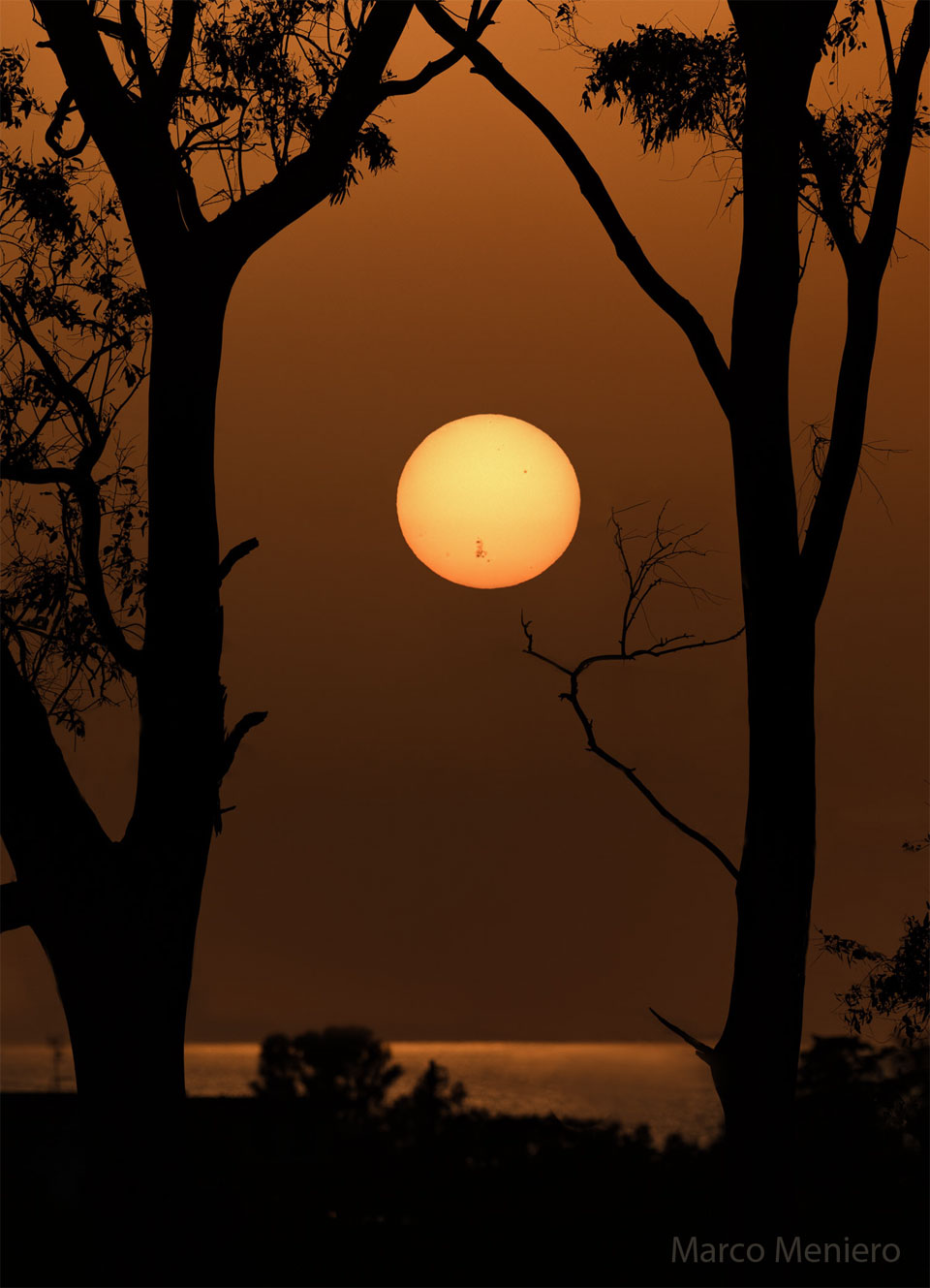
It was larger than the Earth. It was so big you could actually see it on the Sun’s surface without magnification. It contained powerful and tangled magnetic fields as well as numerous dark sunspots. Labelled AR 3664, it developed into one of the most energetic areas seen on the Sun in recent years, unleashing a series of explosions that led to a surge of energetic particles striking the Earth, which created beautiful auroras. And might continue. Although active regions on the Sun like AR 3664 can be quite dangerous, this region’s Coronal Mass Ejections have not done, as yet, much damage to Earth-orbiting satellites or Earth-surface electrical grids. Pictured, the enormous active region was captured on the setting Sun a few days ago from Civitavecchia, Rome, Italy. The composite image includes a very short exposure taken of just the Sun’s surface, but mimics what was actually visible. Finally, AR 3664 is now rotating away from the Earth, although the region may survive long enough to come around again. Gallery: Earth Aurora from Solar Active Region 6443

2024-05-13

Auteur/autrice

pelerinmarc@gmail.com

Publications similaires

Dans

Swift Boost Mission

Parfois, nous avons tous besoin d’un petit coup de pouce d’un ami. L’observatoire Neil Gehrels Swift de la NASA a besoin d’un...

Lire la suite
Dans

NGC 6188: Dragons of Ara

Où peut-on voir des dragons se battre dans le ciel nocturne ? Dans la constellation australe de l’Autel : Ara. Les dragons...

Lire la suite
Dans

Dueling Bands over the Atacama Desert

Quels sont ces deux bandes dans le ciel ? La bande la plus couramment vue est à gauche et est la bande...

Lire la suite
Dans

Saturn’s Iapetus: Painted Moon

Qu’est-il arrivé à la lune de Saturne, Japet ? De vastes régions de ce monde étrange sont noires comme du charbon, tandis...

Lire la suite
Dans

Pathfinder on Mars

Le 4 juillet 1997, en utilisant son propre ensemble de feux d’artifice, un parachute et un cocon d’airbags, le vaisseau spatial Mars...

Lire la suite
Dans

Three Galaxies in Pavo

À environ 190 millions d’années-lumière, bien au-delà des étoiles brillantes et des nébuleuses de la Voie lactée, ces trois galaxies sont attirées...

Lire la suite