×
Dans

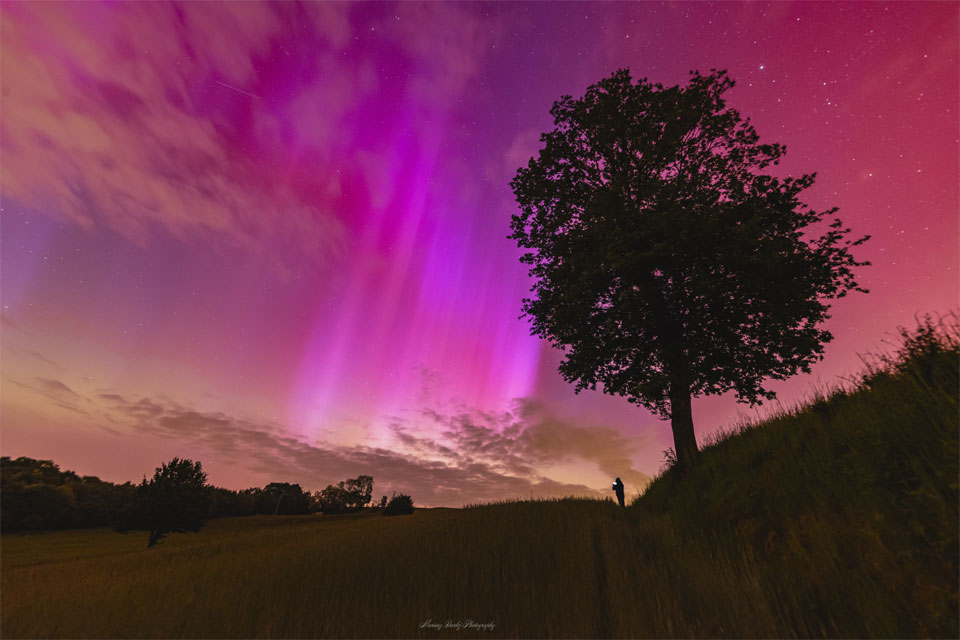
Northern lights don’t usually reach this far south. Magnetic chaos in the Sun’s huge Active Region 3664, however, produced a surface explosion that sent a burst of electrons, protons, and more massive, charged nuclei into the Solar System. A few days later, that coronal mass ejection (CME) impacted the Earth and triggered auroras that are being reported unusually far from our planet’s north and south poles. The free sky show might not be over — the sunspot rich AR3664 has ejected even more CMEs that might also impact the Earth tonight or tomorrow. That active region is now near the Sun’s edge, though, and will soon be rotating away from the Earth. Pictured, a red and rayed aurora was captured in a single 6-second exposure from Racibórz, Poland early last night. The photographer’s friend, seeing an aurora for the first time, is visible in the distance also taking images of the beautifully colorful nighttime sky. Gallery: Global Aurora from Solar Active Region 6443

2024-05-12

Auteur/autrice

pelerinmarc@gmail.com

Publications similaires

Dans

NGC 2170: The Angel Nebula

Est-ce une peinture ou une photographie ? Dans cette œuvre d’art abstraite céleste composée avec un pinceau cosmique, la nébuleuse poussiéreuse NGC...

Lire la suite
Dans

NGC 1300: Barred Spiral Galaxy

Au centre de cette galaxie spirale se trouve une barre. Et au centre de cette barre se trouve une spirale plus petite....

Lire la suite
Dans

Aurora Slathers Up the Sky

Tel une salsa verde sur votre burrito préféré, une aurore verte nappe le ciel dans cette image du 25 juin 2017 prise...

Lire la suite
Dans

R3 PanSTARRS: An Orion Comet

La comète R3 PanSTARRS pourrait être mieux connue comme une comète d’Orion. Une raison principale est que la comète C/2025 R3 (PanSTARRS)...

Lire la suite
Dans

NGC 188: Old Cluster in the New General Catalogue

Le New General Catalogue of star clusters and nebulae n’est en réalité pas si nouveau. Il a été publié en 1888, fruit...

Lire la suite
Dans

NGC 188: Old Cluster in the New General Catalogue

Le « New General Catalog of Star Clusters and Nebulae » n’est en réalité pas si nouveau. Il a été publié en 1888, un...

Lire la suite