×
Dans

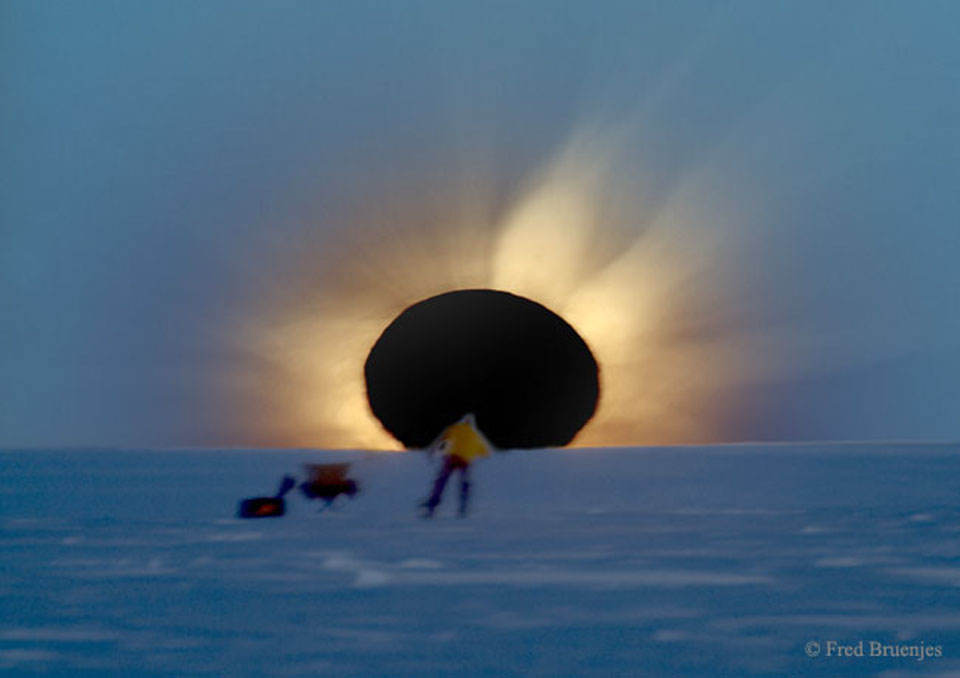
Would you go to the end of the world to see a total eclipse of the Sun? If you did, would you be surprised to find someone else there already? In 2003, the Sun, the Moon, Antarctica, and two photographers all lined up in Antarctica during an unusual total solar eclipse. Even given the extreme location, a group of enthusiastic eclipse chasers ventured near the bottom of the world to experience the surreal momentary disappearance of the Sun behind the Moon. One of the treasures collected was the featured picture — a composite of four separate images digitally combined to realistically simulate how the adaptive human eye saw the eclipse. As the image was taken, both the Moon and the Sun peeked together over an Antarctic ridge. In the sudden darkness, the magnificent corona of the Sun became visible around the Moon. Quite by accident, another photographer was caught in one of the images checking his video camera. Visible to his left are an equipment bag and a collapsible chair. A more easily visible solar eclipse will occur in just under four weeks and be visible from a long, thin swath of North America.

2024-03-10

Auteur/autrice

pelerinmarc@gmail.com

Publications similaires

Dans

The Long Wispy Tail of Comet R3 (PanSTARRS)

Pourquoi la comète R3 (PanSTARRS) a-t-elle une queue vaporeuse ? Le plus récent membre brillant du système solaire interne, la comète C/2025...

Lire la suite
Dans

NGC 602 and Beyond

Les nuages peuvent ressembler à des huîtres, et les étoiles à des perles, mais regardez au-delà. Près de la périphérie du Petit...

Lire la suite
Dans

Comet R3 (PanSTARRS) Brightens

La comète R3 s’illumine rapidement : survivra-t-elle ? La comète C/2025 R3 (PanSTARRS) s’illumine lentement et déploie une queue d’ions depuis sa...

Lire la suite
Dans

Artemis II: Flight Day 6

Au jour de vol 6 (6 avril), la mission Artemis II a réalisé un survol lunaire historique. En contournant la face cachée...

Lire la suite
Dans

Exploring the Antennae

À environ 60 millions d’années-lumière de distance, dans la constellation australe du Corbeau, deux grandes galaxies sont en collision. Les étoiles des...

Lire la suite
Dans

Destruction of Comet C/2026 A1 (MAPS)

Alors que l’équipage d’Artemis II voyageait vers la Lune cette semaine, la comète C/2026 A1 (MAPS) devait connaître son approche la plus...

Lire la suite