×
Dans

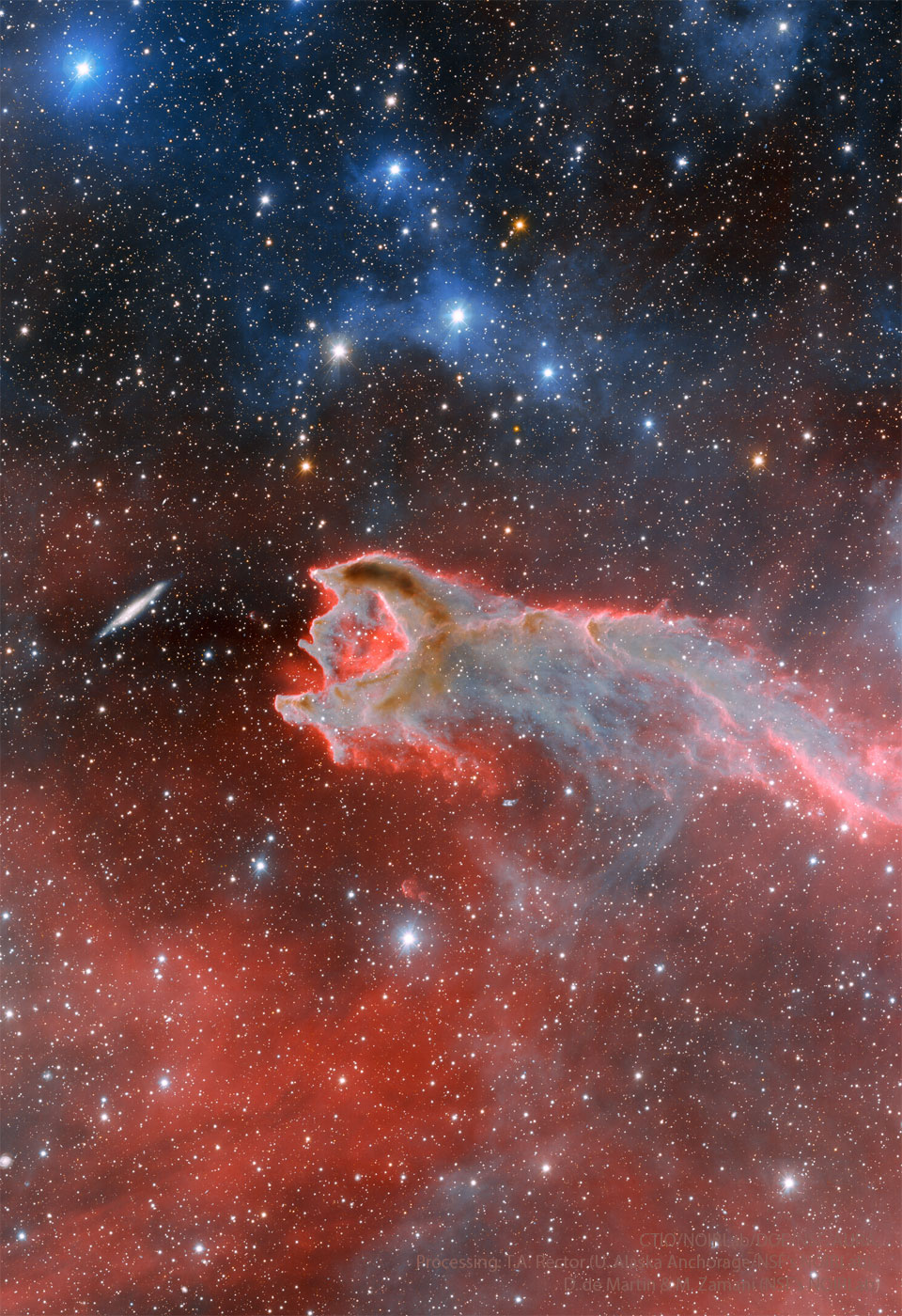
Can a gas cloud eat a galaxy? It’s not even close. The « claw » of this odd looking « creature » in the featured photo is a gas cloud known as a cometary globule. This globule, however, has ruptured. Cometary globules are typically characterized by dusty heads and elongated tails. These features cause cometary globules to have visual similarities to comets, but in reality they are very much different. Globules are frequently the birthplaces of stars, and many show very young stars in their heads. The reason for the rupture in the head of this object is not yet known. The galaxy to the left of the globule is huge, very far in the distance, and only placed near CG4 by chance superposition.

2024-05-21

Auteur/autrice

pelerinmarc@gmail.com

Publications similaires

Dans

Swift Boost Mission

Parfois, nous avons tous besoin d’un petit coup de pouce d’un ami. L’observatoire Neil Gehrels Swift de la NASA a besoin d’un...

Lire la suite
Dans

NGC 6188: Dragons of Ara

Où peut-on voir des dragons se battre dans le ciel nocturne ? Dans la constellation australe de l’Autel : Ara. Les dragons...

Lire la suite
Dans

Dueling Bands over the Atacama Desert

Quels sont ces deux bandes dans le ciel ? La bande la plus couramment vue est à gauche et est la bande...

Lire la suite
Dans

Saturn’s Iapetus: Painted Moon

Qu’est-il arrivé à la lune de Saturne, Japet ? De vastes régions de ce monde étrange sont noires comme du charbon, tandis...

Lire la suite
Dans

Pathfinder on Mars

Le 4 juillet 1997, en utilisant son propre ensemble de feux d’artifice, un parachute et un cocon d’airbags, le vaisseau spatial Mars...

Lire la suite
Dans

Three Galaxies in Pavo

À environ 190 millions d’années-lumière, bien au-delà des étoiles brillantes et des nébuleuses de la Voie lactée, ces trois galaxies sont attirées...

Lire la suite