×
Dans

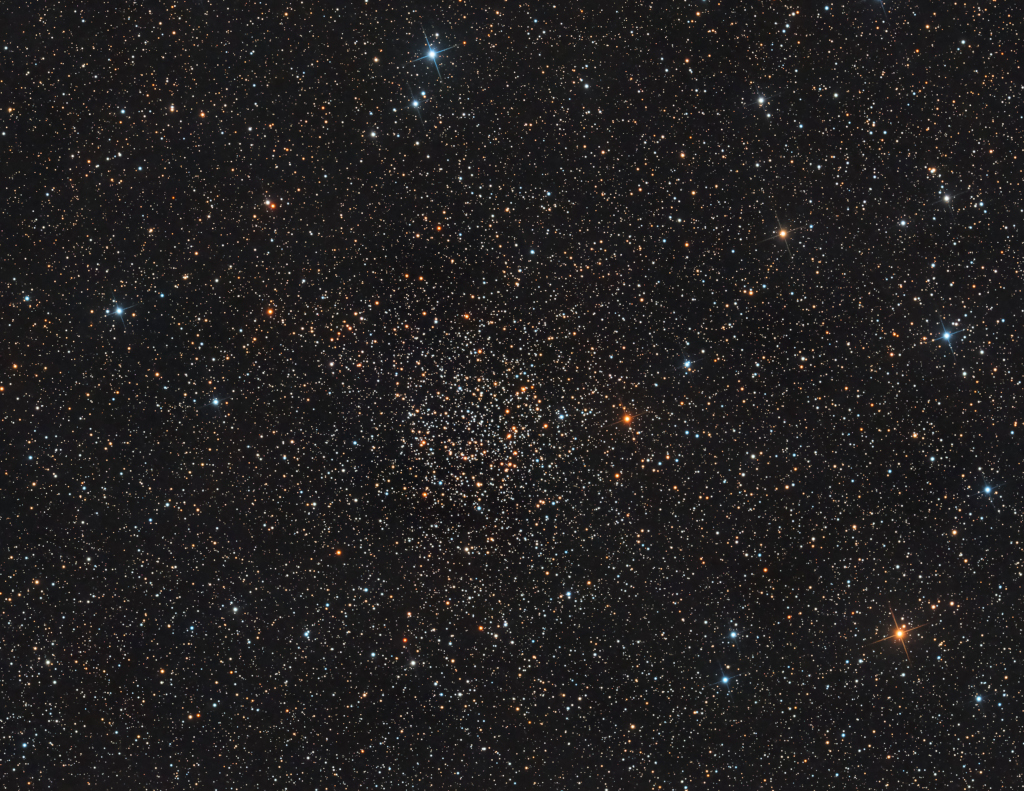
Found among the rich starfields of the Milky Way, star cluster NGC 7789 lies about 8,000 light-years away toward the constellation Cassiopeia. A late 18th century deep sky discovery of astronomer Caroline Lucretia Herschel, the cluster is also known as Caroline’s Rose. Its visual appearance in small telescopes, created by the cluster’s complex of stars and voids, is suggestive of nested rose petals. Now estimated to be 1.6 billion years young, the galactic or open cluster of stars also shows its age. All the stars in the cluster were likely born at the same time, but the brighter and more massive ones have more rapidly exhausted the hydrogen fuel in their cores. These have evolved from main sequence stars like the Sun into the many red giant stars shown with a yellowish cast in this color composite. Using measured color and brightness, astronomers can model the mass and hence the age of the cluster stars just starting to « turn off » the main sequence and become red giants. Over 50 light-years across, Caroline’s Rose spans about half a degree (the angular size of the Moon) near the center of the sharp telescopic image.

2024-07-06

Auteur/autrice

marcpm@gmail.com

Publications similaires

Dans

Comet R3 PanSTARRS over a Himalayan Valley

La meilleure façon d’observer la longue queue de la comète R3 PanSTARRS est avec un appareil photo. Cette semaine, la comète récemment...

Lire la suite
Dans

Eye on the Milky Way

Avez-vous déjà eu des étoiles dans les yeux ? Il semble que l’œil de gauche en ait, et de plus, il semble...

Lire la suite
Dans

PanSTARRS and Planets

Près de l’horizon est avant le lever du soleil, la comète C/2025 R3 PanSTARRS devient plus brillante. Facilement visible aux jumelles et...

Lire la suite
Dans

M82: Starburst Galaxy with a Superwind

M82 est une galaxie à sursaut de formation d’étoiles, dotée d’un « supervent ». En effet, par le biais d’explosions de supernovae et de...

Lire la suite
Dans

South Celestial Tree

Si vous vivez dans l’hémisphère nord, vous avez peut-être appris à repérer l’étoile Polaire, Polaris, dans le ciel nocturne. Elle peut être...

Lire la suite
Dans

The Long Wispy Tail of Comet R3 (PanSTARRS)

Pourquoi la comète R3 (PanSTARRS) a-t-elle une queue vaporeuse ? Le plus récent membre brillant du système solaire interne, la comète C/2025...

Lire la suite