×
Dans

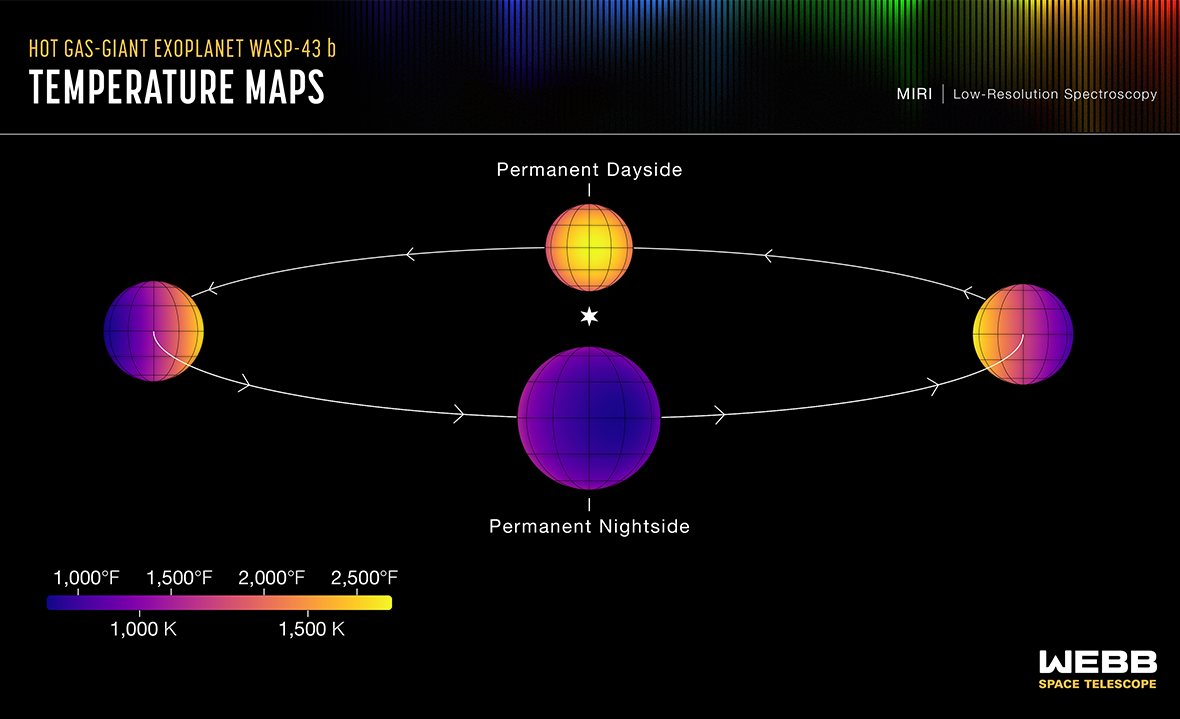
A mere 280 light-years from Earth, tidally locked, Jupiter-sized exoplanet WASP-43b orbits its parent star once every 0.8 Earth days. That puts it about 2 million kilometers (less than 1/25th the orbital distance of Mercury) from a small, cool sun. Still, on a dayside always facing its parent star, temperatures approach a torrid 2,500 degrees F as measured at infrared wavelengths by the MIRI instrument on board the James Webb Space Telescope. In this illustration of the hot exoplanet’s orbit, Webb measurements also show nightside temperatures remain above 1,000 degrees F. That suggests that strong equatorial winds circulate the dayside atmospheric gases to the nightside before they can completely cool off. Exoplanet WASP-43b is now formally known as Astrolábos, and its K-type parent star has been christened Gnomon. Webb’s infrared spectra indicate water vapor is present on the nightside as well as the dayside of the planet, providing information about cloud cover on Astrolábos.

2024-05-03

Auteur/autrice

pelerinmarc@gmail.com

Publications similaires

Dans

The Long Wispy Tail of Comet R3 (PanSTARRS)

Pourquoi la comète R3 (PanSTARRS) a-t-elle une queue vaporeuse ? Le plus récent membre brillant du système solaire interne, la comète C/2025...

Lire la suite
Dans

NGC 602 and Beyond

Les nuages peuvent ressembler à des huîtres, et les étoiles à des perles, mais regardez au-delà. Près de la périphérie du Petit...

Lire la suite
Dans

Comet R3 (PanSTARRS) Brightens

La comète R3 s’illumine rapidement : survivra-t-elle ? La comète C/2025 R3 (PanSTARRS) s’illumine lentement et déploie une queue d’ions depuis sa...

Lire la suite
Dans

Artemis II: Flight Day 6

Au jour de vol 6 (6 avril), la mission Artemis II a réalisé un survol lunaire historique. En contournant la face cachée...

Lire la suite
Dans

Exploring the Antennae

À environ 60 millions d’années-lumière de distance, dans la constellation australe du Corbeau, deux grandes galaxies sont en collision. Les étoiles des...

Lire la suite
Dans

Destruction of Comet C/2026 A1 (MAPS)

Alors que l’équipage d’Artemis II voyageait vers la Lune cette semaine, la comète C/2026 A1 (MAPS) devait connaître son approche la plus...

Lire la suite