×
Dans

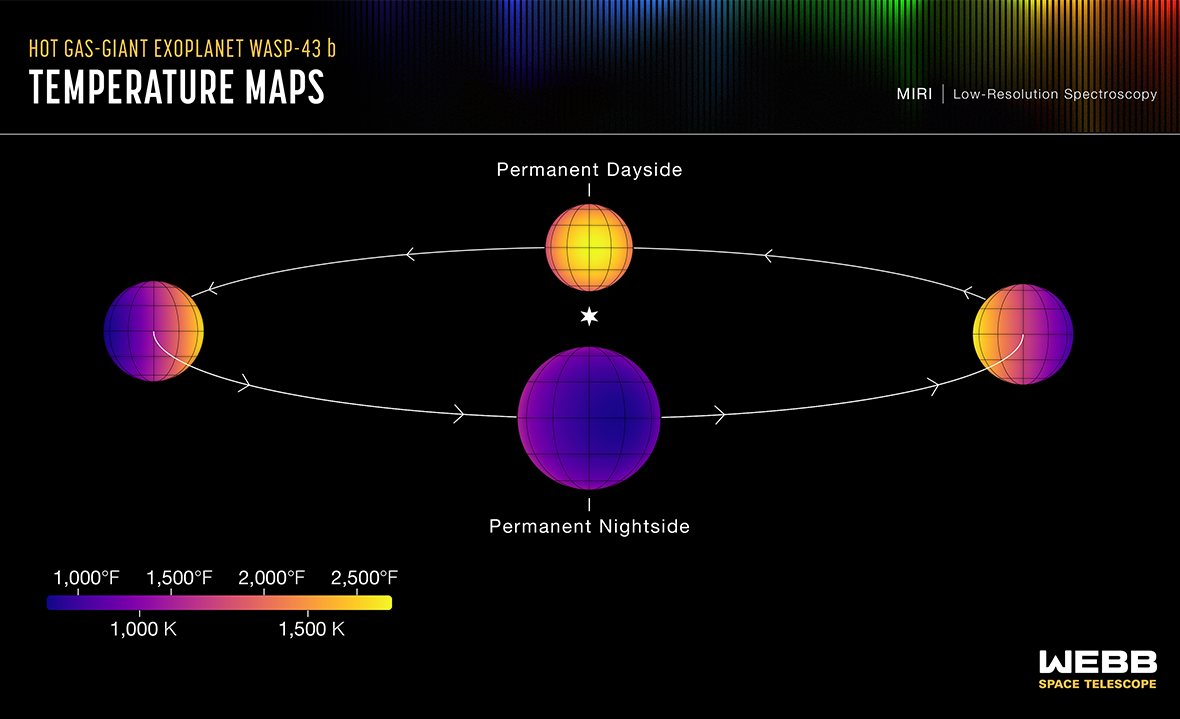
A mere 280 light-years from Earth, tidally locked, Jupiter-sized exoplanet WASP-43b orbits its parent star once every 0.8 Earth days. That puts it about 2 million kilometers (less than 1/25th the orbital distance of Mercury) from a small, cool sun. Still, on a dayside always facing its parent star, temperatures approach a torrid 2,500 degrees F as measured at infrared wavelengths by the MIRI instrument on board the James Webb Space Telescope. In this illustration of the hot exoplanet’s orbit, Webb measurements also show nightside temperatures remain above 1,000 degrees F. That suggests that strong equatorial winds circulate the dayside atmospheric gases to the nightside before they can completely cool off. Exoplanet WASP-43b is now formally known as Astrolábos, and its K-type parent star has been christened Gnomon. Webb’s infrared spectra indicate water vapor is present on the nightside as well as the dayside of the planet, providing information about cloud cover on Astrolábos.

2024-05-03

Auteur/autrice

pelerinmarc@gmail.com

Publications similaires

Dans

A Message from Earth

Qu’essaient de nous dire ces Terriens ? Le message mis en avant a été diffusé depuis la Terre vers l’amas globulaire M13...

Lire la suite
Dans

Robert Goddard and Nell

Robert H. Goddard, considéré comme le père de la fuséologie moderne, est né à Worcester, Massachusetts, en 1882. À 16 ans, Goddard...

Lire la suite
Dans

Hickson 44 in Leo

En scrutant le ciel à la recherche de galaxies, l’astronome canadien Paul Hickson et ses collègues ont identifié environ 100 groupes de...

Lire la suite
Dans

Black Holes and Neutron Stars: 218 Mergers and Counting

Quel est le son de la fusion de deux trous noirs dans l’espace profond ? Les ondes sonores ne se propagent pas...

Lire la suite
Dans

The Guardians of Rapa Nui beneath the Milky Way

Selon les mots de l’astrophotographe d’aujourd’hui, Rositsa Dimitrova, « Qu’ont vu ces sentinelles silencieuses traverser le ciel ? » Les mo’ai volcaniques (qui signifie...

Lire la suite
Dans

Light Pillars and Orion over Mohe

Que se passe-t-il au bout de cette rue ? Ce que l’on voit ici ne sont pas des aurores boréales, mais des...

Lire la suite