×
Dans

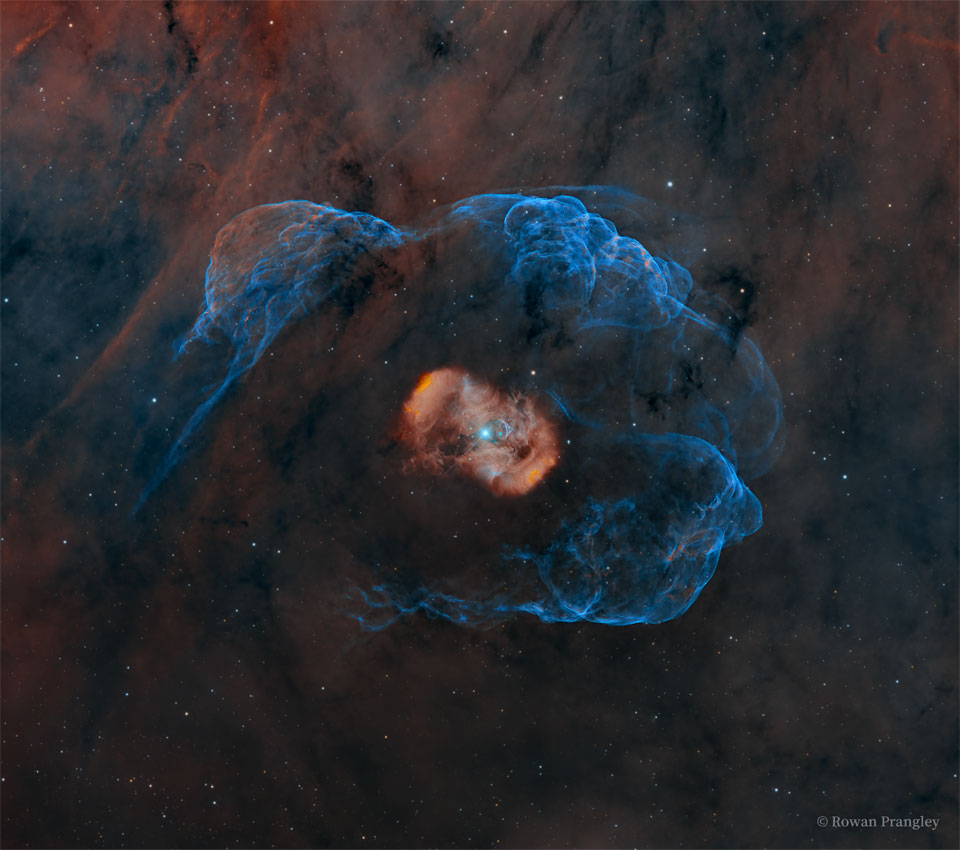
How did a star form this beautiful nebula? In the middle of emission nebula NGC 6164 is an unusually massive star. The central star has been compared to an oyster’s pearl and an egg protected by the mythical sky dragons of Ara. The star, visible in the center of the featured image and catalogued as HD 148937, is so hot that the ultraviolet light it emits heats up gas that surrounds it. That gas was likely thrown off from the star previously, possibly the result of a gravitational interaction with a looping stellar companion. Expelled material might have been channeled by the magnetic field of the massive star, in all creating the symmetric shape of the bipolar nebula. NGC 6164 spans about four light years and is located about 3,600 light years away toward the southern constellation Norma. New Mirror: APOD now available via WhatsApp

2024-04-24

Auteur/autrice

pelerinmarc@gmail.com

Publications similaires

Dans

Cygnus and the Solitary Tree

Un arbre solitaire se dresse dans une prairie tranquille à Guadalajara, en Espagne, se découpant sur la région du Cygne qui s’élève...

Lire la suite
Dans

The Tadpoles of IC 410

Cette vue télescopique en gros plan révèle les régions centrales de la nébuleuse en émission IC 410, autrement faible, capturée sous le...

Lire la suite
Dans

NGC 1566: The Spanish Dancer Galaxy

Sinon parfaite, cette galaxie spirale est au moins l’une des plus photogéniques. Univers îlot contenant des milliards d’étoiles et situé à environ...

Lire la suite
Dans

Equinox at the Pyramid of the Feathered Serpent

Pour voir le serpent à plumes descendre la pyramide maya, il faut un timing parfait. Vous devez visiter El Castillo — dans...

Lire la suite
Dans

A Year for K2-315b

Envie de visiter une planète qui a 3,14 jours dans une année ? Alors prévoyez un voyage vers K2-315b, une planète de...

Lire la suite
Dans

Toolondo Totality Trails

Dans ce paysage nocturne composite, des expositions empilées tracent de gracieux traînées d’étoiles au-dessus du lac Toolondo, Victoria, Australie, planète Terre. Capturées...

Lire la suite