×
Dans

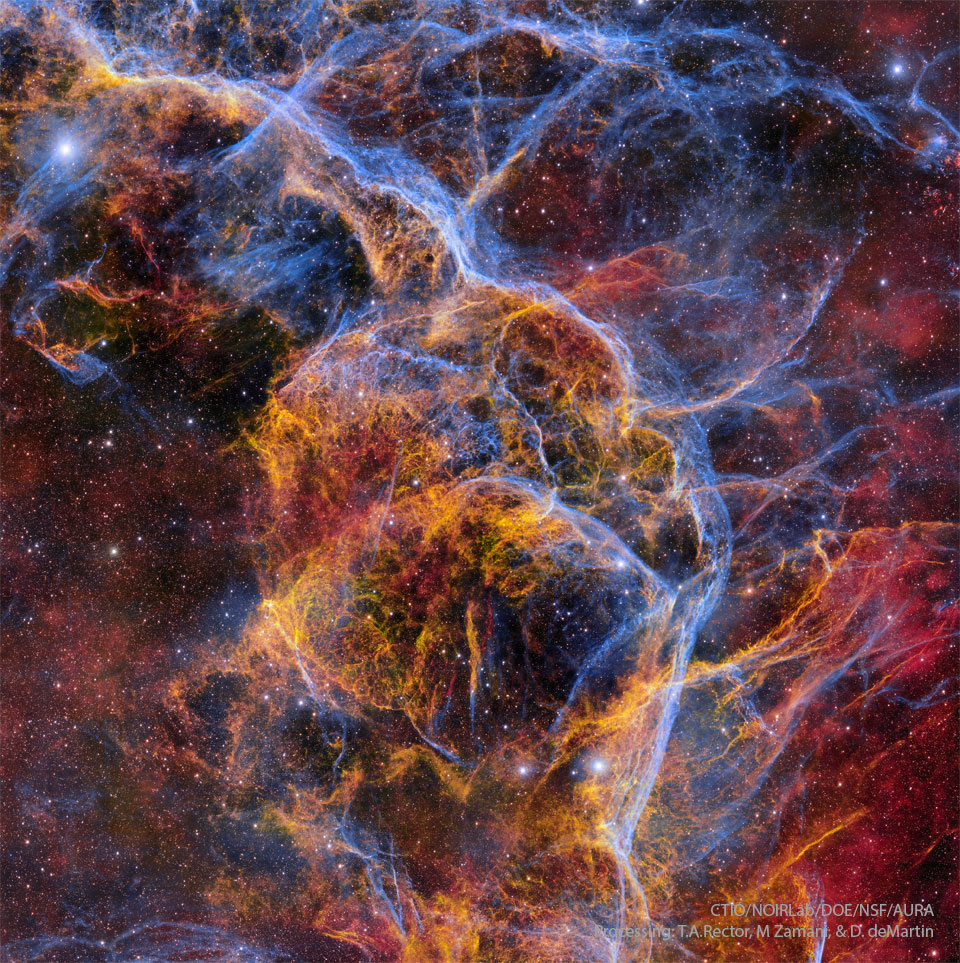
The explosion is over, but the consequences continue. About eleven thousand years ago, a star in the constellation of Vela could be seen to explode, creating a strange point of light briefly visible to humans living near the beginning of recorded history. The outer layers of the star crashed into the interstellar medium, driving a shock wave that is still visible today. The featured image captures some of that filamentary and gigantic shock in visible light. As gas flies away from the detonated star, it decays and reacts with the interstellar medium, producing light in many different colors and energy bands. Remaining at the center of the Vela Supernova Remnant is a pulsar, a star as dense as nuclear matter that spins around more than ten times in a single second. Monday’s Eclipse Imagery: Notable Submissions to APOD

2024-04-16

Auteur/autrice

pelerinmarc@gmail.com

Publications similaires

Dans

Comet R3 PanSTARRS Before Rigel

Dans quelle direction va la comète R3 PanSTARRS ? Pas vers l’étoile en haut de l’image, car il s’agit de Rigel, qui,...

Lire la suite
Dans

The Retrograde Dance of Saturn and Neptune

Que signifie la rétrogradation de Saturne et Neptune ? La photo est un assemblage d’images prises sur 34 nuits entre mai 2025...

Lire la suite
Dans

Orion over Mount Teide

Orion est rarement visible ainsi. Pour obtenir cette majestueuse perspective, il faut un appareil photo capable de réaliser des expositions de si...

Lire la suite
Dans

Trifid Pillars and Jets

Les piliers de poussière sont comme des montagnes interstellaires. Ils survivent car ils sont plus denses que leur environnement, mais ils sont...

Lire la suite
Dans

Seeing Titan

Enveloppée dans une atmosphère épaisse, la surface de Titan, la plus grande lune de Saturne, est très difficile à observer. De petites...

Lire la suite
Dans

Markarian’s Chain

Près du cœur de l’amas de galaxies de la Vierge, une chaîne de galaxies connue sous le nom de Chaîne de Markarian...

Lire la suite