×
Dans

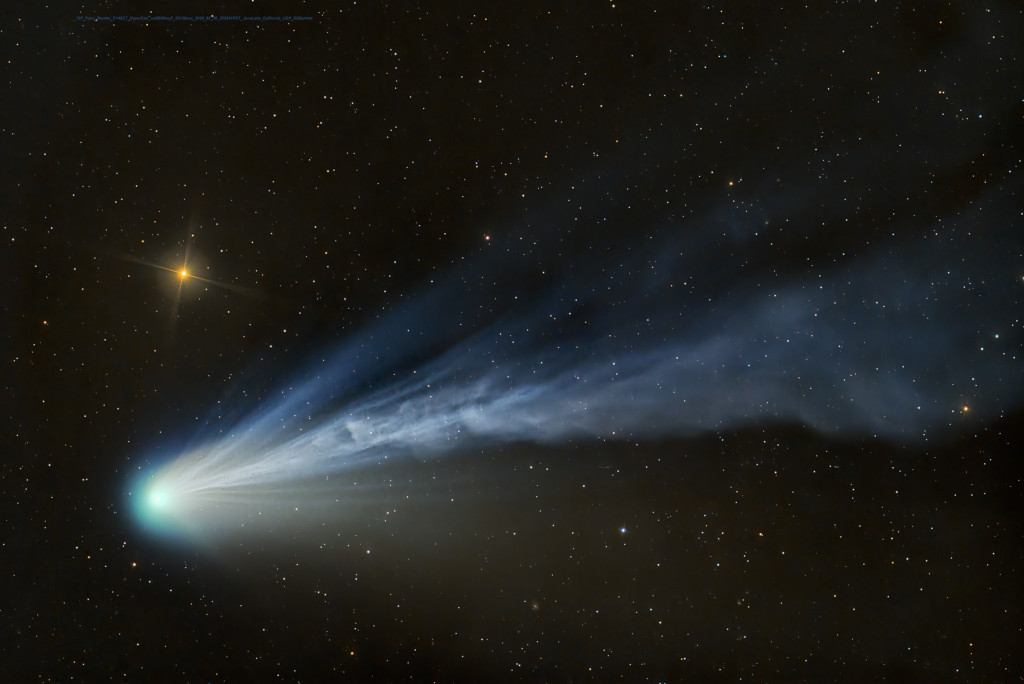
In dark evening skies over June Lake, northern hemisphere, planet Earth, Comet 12P/Pons-Brooks stood just above the western horizon on March 30. Its twisted turbulent ion tail and diffuse greenish coma are captured in this two degree wide telescopic field of view along with bright yellowish star Hamal also known as Alpha Arietis. Now Pons-Brooks has moved out of the northern night though, approaching perihelion on April 21. On April 8 you might still spot the comet in daytime skies. But to do it, you will have to stand in the path of totality and look away from the spectacle of an alluring solar corona and totally eclipsed Sun. NASA Coverage: Total Solar Eclipse of 2024 April 8

2024-04-04

Auteur/autrice

pelerinmarc@gmail.com

Publications similaires

Dans

Unicorn, Fox Fur and Christmas Tree

Une région de formation d’étoiles cataloguée sous le nom de NGC 2264, cet agencement magnifique mais complexe de gaz et de poussière...

Lire la suite
Dans

Mystery: Little Red Dots in the Early Universe

Que sont ces petits points rouges (PPR) ? Personne ne le sait. Découverts seulement l’année dernière, des centaines de PPR ont maintenant...

Lire la suite
Dans

Red Sprites and Circular Elves Lightning over Italy

Que se passe-t-il dans le ciel ? Des éclairs. Le type d’éclair le plus souvent observé se manifeste par des éclairs de...

Lire la suite
Dans

Sunset Solstice over Stonehenge

Hier, le Soleil a atteint son point le plus méridional dans le ciel de la planète Terre. Cet événement, appelé solstice, marque...

Lire la suite
Dans

Solstice on a Spinning Earth

  Peut-on déduire qu’aujourd’hui est un solstice grâce à l’inclinaison de la Terre ? Oui. Lors d’un solstice, le terminateur de la...

Lire la suite
Dans

A Solstice Sun Tattoo

Le mot solstice vient du latin *Sol* (soleil) et *sistere* (s’arrêter ou se tenir immobile). Et durant les jours qui entourent un...

Lire la suite