×
Dans

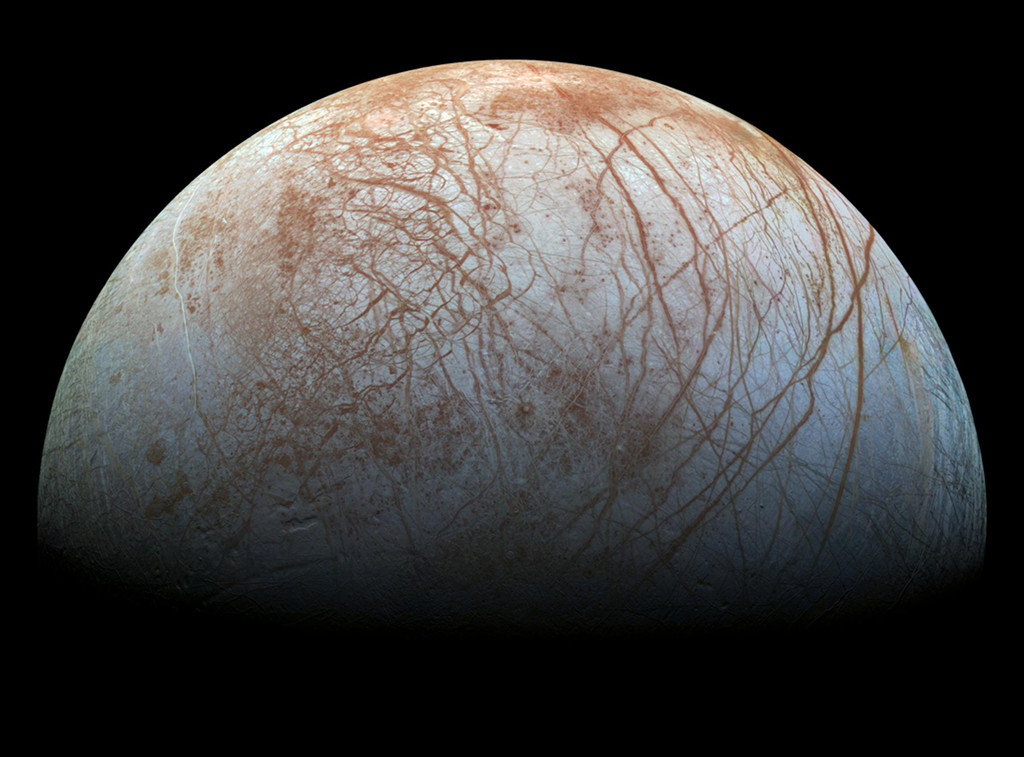
Looping through the Jovian system in the late 1990s, the Galileo spacecraft recorded stunning views of Europa and uncovered evidence that the moon’s icy surface likely hides a deep, global ocean. Galileo’s Europa image data has been remastered here, with improved calibrations to produce a color image approximating what the human eye might see. Europa’s long curving fractures hint at the subsurface liquid water. The tidal flexing the large moon experiences in its elliptical orbit around Jupiter supplies the energy to keep the ocean liquid. But more tantalizing is the possibility that even in the absence of sunlight that process could also supply the energy to support life, making Europa one of the best places to look for life beyond Earth. The Juno spacecraft currently in Jovian orbit has also made repeated flybys of the water world, returning images along with data exploring Europa’s habitability. This October will see the launch of the NASA’s Europa Clipper on a voyage of exploration. The spacecraft will make nearly 50 flybys, approaching to within 25 kilometers of Europa’s icy surface.

2024-03-29

Auteur/autrice

pelerinmarc@gmail.com

Publications similaires

Dans

NGC 1300: Barred Spiral Galaxy

Au centre de cette galaxie spirale se trouve une barre. Et au centre de cette barre se trouve une spirale plus petite....

Lire la suite
Dans

Aurora Slathers Up the Sky

Tel une salsa verde sur votre burrito préféré, une aurore verte nappe le ciel dans cette image du 25 juin 2017 prise...

Lire la suite
Dans

R3 PanSTARRS: An Orion Comet

La comète R3 PanSTARRS pourrait être mieux connue comme une comète d’Orion. Une raison principale est que la comète C/2025 R3 (PanSTARRS)...

Lire la suite
Dans

NGC 188: Old Cluster in the New General Catalogue

Le New General Catalogue of star clusters and nebulae n’est en réalité pas si nouveau. Il a été publié en 1888, fruit...

Lire la suite
Dans

NGC 188: Old Cluster in the New General Catalogue

Le « New General Catalog of Star Clusters and Nebulae » n’est en réalité pas si nouveau. Il a été publié en 1888, un...

Lire la suite
Dans

The Conjunction of Comet R3 PanSTARRS and the Orion Nebula

L’image composite d’aujourd’hui présente quelque chose de vieux, quelque chose de neuf, quelque chose d’emprunté et quelque chose de bleu ! La...

Lire la suite