×
Dans

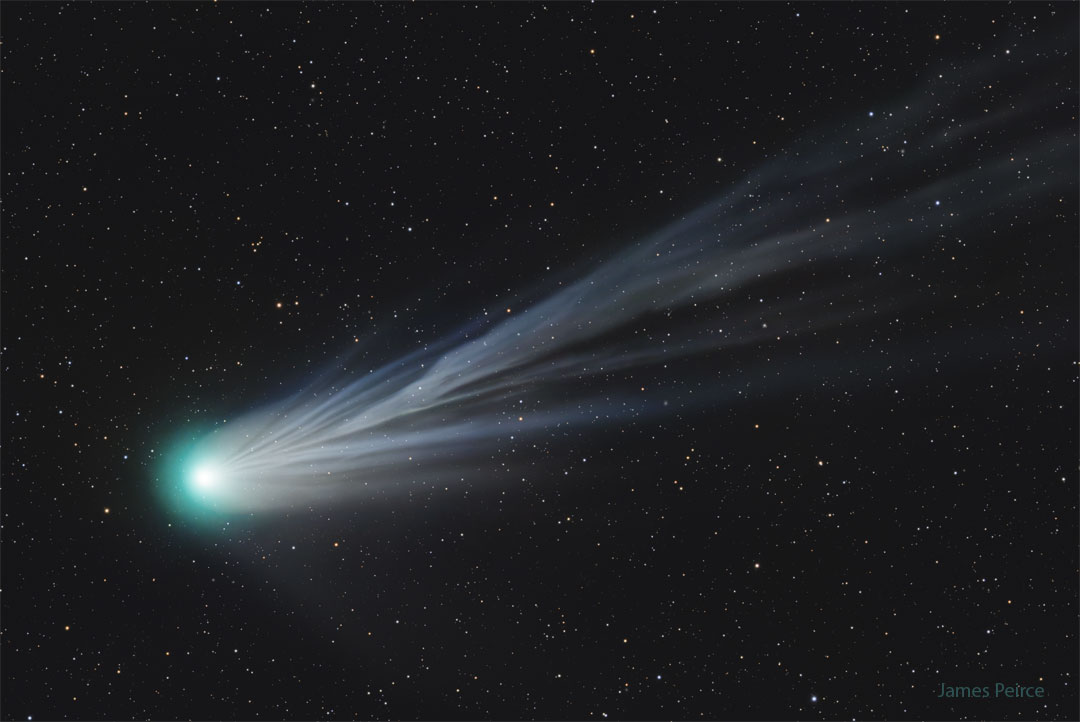
Comet Pons-Brooks has quite a tail to tell. First discovered in 1385, this erupting dirty snowball loops back into our inner Solar System every 71 years and, this time, is starting to put on a show for deep camera exposures. In the featured picture, the light blue stream is the ion tail which consists of charged molecules pushed away from the comet’s nucleus by the solar wind. The ion tail, shaped by the Sun’s wind and the comet’s core’s rotation, always points away from the Sun. Comet 12P/Pons–Brooks is now visible with binoculars in the early evening sky toward the northwest, moving perceptibly from night to night. The frequently flaring comet is expected to continue to brighten, on the average, and may even become visible with the unaided eye — during the day — to those in the path of totality of the coming solar eclipse on April 8.

2024-03-26

Auteur/autrice

pelerinmarc@gmail.com

Publications similaires

Dans

Cygnus and the Solitary Tree

Un arbre solitaire se dresse dans une prairie tranquille à Guadalajara, en Espagne, se découpant sur la région du Cygne qui s’élève...

Lire la suite
Dans

The Tadpoles of IC 410

Cette vue télescopique en gros plan révèle les régions centrales de la nébuleuse en émission IC 410, autrement faible, capturée sous le...

Lire la suite
Dans

NGC 1566: The Spanish Dancer Galaxy

Sinon parfaite, cette galaxie spirale est au moins l’une des plus photogéniques. Univers îlot contenant des milliards d’étoiles et situé à environ...

Lire la suite
Dans

Equinox at the Pyramid of the Feathered Serpent

Pour voir le serpent à plumes descendre la pyramide maya, il faut un timing parfait. Vous devez visiter El Castillo — dans...

Lire la suite
Dans

A Year for K2-315b

Envie de visiter une planète qui a 3,14 jours dans une année ? Alors prévoyez un voyage vers K2-315b, une planète de...

Lire la suite
Dans

Toolondo Totality Trails

Dans ce paysage nocturne composite, des expositions empilées tracent de gracieux traînées d’étoiles au-dessus du lac Toolondo, Victoria, Australie, planète Terre. Capturées...

Lire la suite