×
Dans

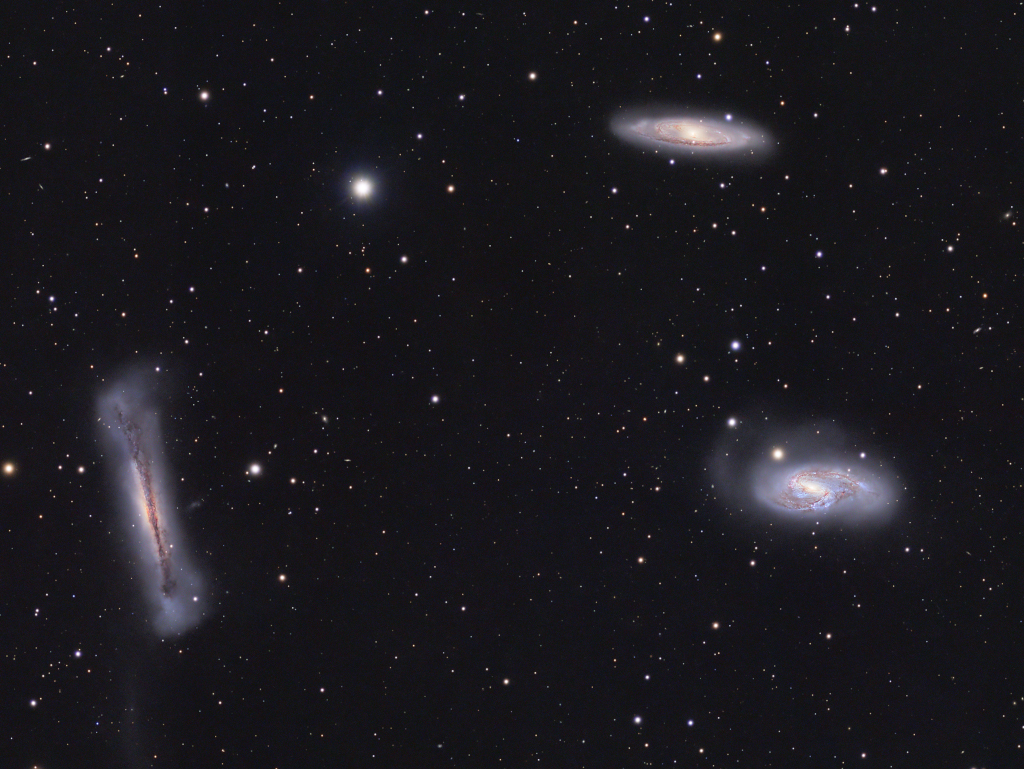
This popular group leaps into the early evening sky around the March equinox and the northern hemisphere spring. Famous as the Leo Triplet, the three magnificent galaxies found in the prominent constellation Leo gather here in one astronomical field of view. Crowd pleasers when imaged with even modest telescopes, they can be introduced individually as NGC 3628 (left), M66 (bottom right), and M65 (top). All three are large spiral galaxies but tend to look dissimilar, because their galactic disks are tilted at different angles to our line of sight. NGC 3628, also known as the Hamburger Galaxy, is temptingly seen edge-on, with obscuring dust lanes cutting across its puffy galactic plane. The disks of M66 and M65 are both inclined enough to show off their spiral structure. Gravitational interactions between galaxies in the group have left telltale signs, including the tidal tails and warped, inflated disk of NGC 3628 and the drawn out spiral arms of M66. This gorgeous view of the region spans over 1 degree (two full moons) on the sky in a frame that covers over half a million light-years at the trio’s estimated distance of 30 million light-years.

2024-03-21

Auteur/autrice

pelerinmarc@gmail.com

Publications similaires

Dans

Comet R3 PanSTARRS over a Himalayan Valley

La meilleure façon d’observer la longue queue de la comète R3 PanSTARRS est avec un appareil photo. Cette semaine, la comète récemment...

Lire la suite
Dans

Eye on the Milky Way

Avez-vous déjà eu des étoiles dans les yeux ? Il semble que l’œil de gauche en ait, et de plus, il semble...

Lire la suite
Dans

PanSTARRS and Planets

Près de l’horizon est avant le lever du soleil, la comète C/2025 R3 PanSTARRS devient plus brillante. Facilement visible aux jumelles et...

Lire la suite
Dans

M82: Starburst Galaxy with a Superwind

M82 est une galaxie à sursaut de formation d’étoiles, dotée d’un « supervent ». En effet, par le biais d’explosions de supernovae et de...

Lire la suite
Dans

South Celestial Tree

Si vous vivez dans l’hémisphère nord, vous avez peut-être appris à repérer l’étoile Polaire, Polaris, dans le ciel nocturne. Elle peut être...

Lire la suite
Dans

The Long Wispy Tail of Comet R3 (PanSTARRS)

Pourquoi la comète R3 (PanSTARRS) a-t-elle une queue vaporeuse ? Le plus récent membre brillant du système solaire interne, la comète C/2025...

Lire la suite