×
Dans

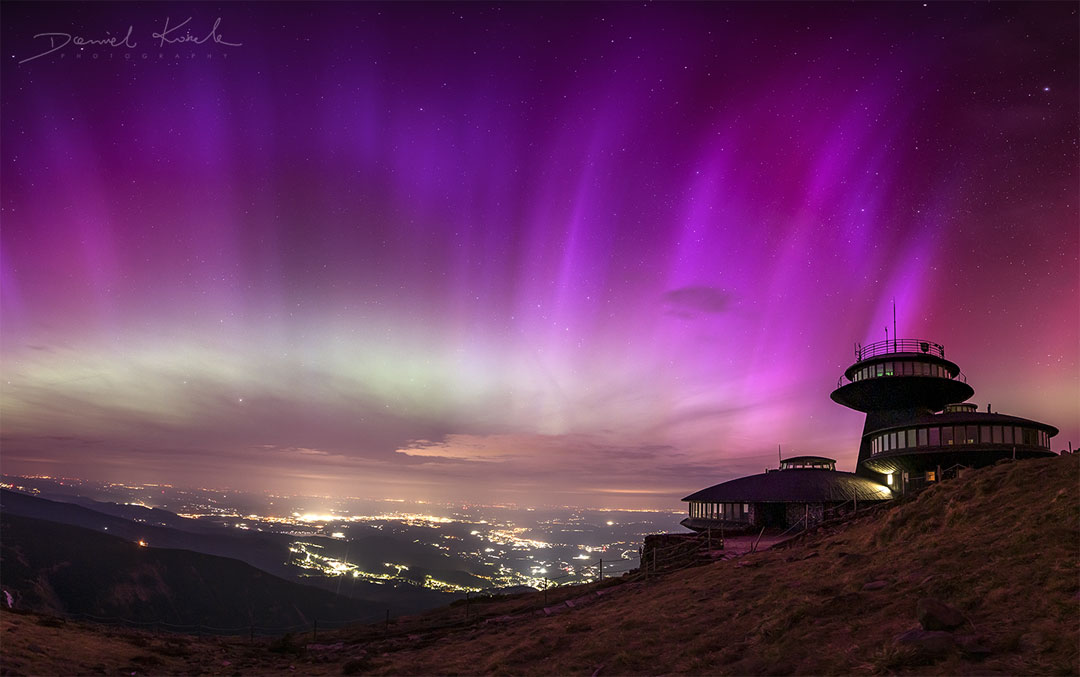
It was the first time ever. At least, the first time this photographer had ever seen aurora from his home mountains. And what a spectacular aurora it was. The Karkonosze Mountains in Poland are usually too far south to see any auroras. But on the amazing night of May 10 – 11, purple and green colors lit up much of the night sky, a surprising spectacle that also appeared over many mid-latitude locations around the Earth. The featured image is a composite of six vertical exposures taken during the auroral peak. The futuristic buildings on the right are part of a meteorological observatory located on the highest peak of the Karkonosze Mountains. The purple color is primarily due to Sun-triggered, high-energy electrons impacting nitrogen molecules in Earth’s atmosphere. Our Sun is reaching its maximum surface activity over the next two years, and although many more auroras are predicted, most will occur over regions closer to the Earth’s poles.

2024-06-12

Auteur/autrice

pelerinmarc@gmail.com

Publications similaires

Dans

Black Holes and Neutron Stars: 218 Mergers and Counting

Quel est le son de la fusion de deux trous noirs dans l’espace profond ? Les ondes sonores ne se propagent pas...

Lire la suite
Dans

The Guardians of Rapa Nui beneath the Milky Way

Selon les mots de l’astrophotographe d’aujourd’hui, Rositsa Dimitrova, « Qu’ont vu ces sentinelles silencieuses traverser le ciel ? » Les mo’ai volcaniques (qui signifie...

Lire la suite
Dans

Light Pillars and Orion over Mohe

Que se passe-t-il au bout de cette rue ? Ce que l’on voit ici ne sont pas des aurores boréales, mais des...

Lire la suite
Dans

Leaving Earth

À quoi ressemblerait-on en quittant la planète Terre ? Un tel événement a été enregistré visuellement avec beaucoup de détails par la...

Lire la suite
Dans

Galaxies in the River: NGC 1300 and NGC 1297

La spirale NGC 1300 et l’elliptique NGC 1297 sont des galaxies situées sur les rives de la constellation australe de l’Éridan (Le...

Lire la suite
Dans

Spring Equinox at Teide Observatory

Le moment astronomique définissant l’équinoxe aujourd’hui est à 14h46 UTC (20 mars). C’est à ce moment que le Soleil traverse l’équateur céleste...

Lire la suite