×
Dans

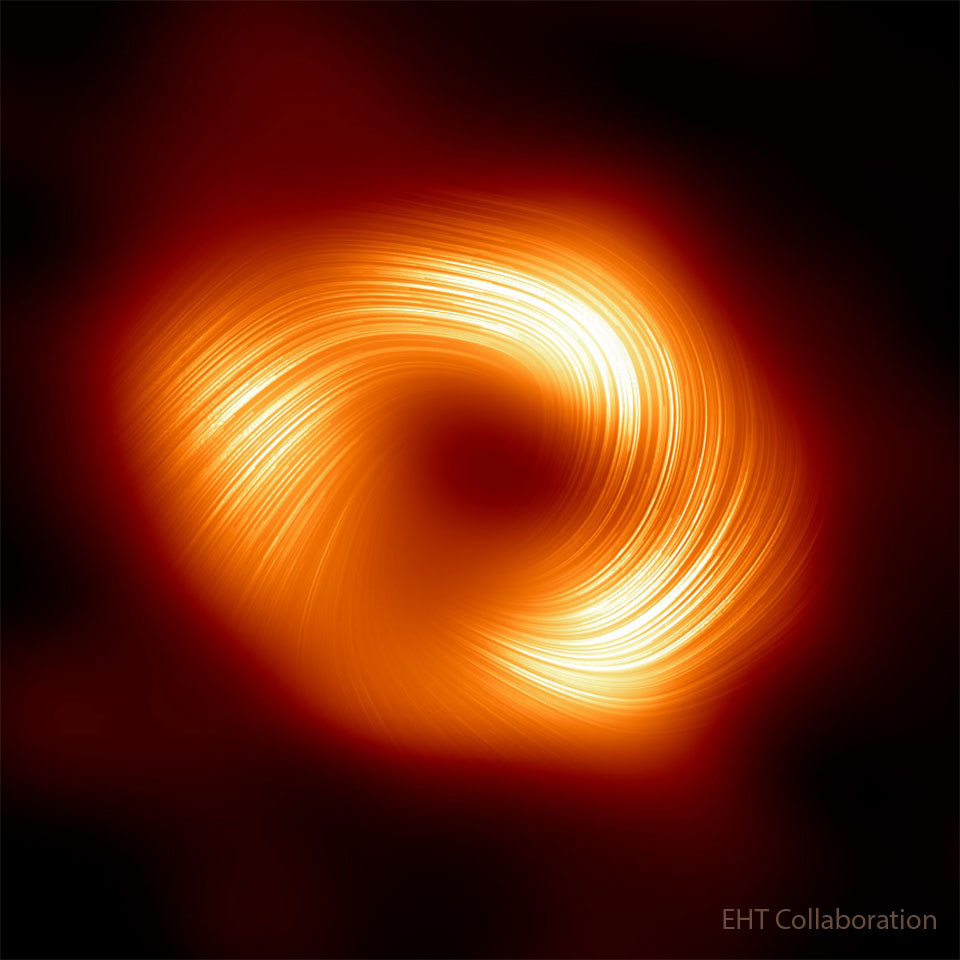
What’s happening to the big black hole in the center of our galaxy? It is sucking in matter from a swirling disk — a disk that is magnetized, it has now been confirmed. Specifically, the black hole’s accretion disk has recently been seen to emit polarized light, radiation frequently associated with a magnetized source. Pictured here is a close-up of Sgr A*, our Galaxy’s central black hole, taken by radio telescopes around the world participating in the Event Horizon Telescope (EHT) Collaboration. Superposed are illustrative curved lines indicating polarized light likely emitted from swirling magnetized gas that will soon fall into the 4+ million mass central black hole. The central part of this image is likely dark because little light-emitting gas is visible between us and the dark event horizon of the black hole. Continued EHT monitoring of this and M87’s central black hole may yield new clues about the gravity of black holes and how infalling matter creates disks and jets. NASA Predicts: Moon to Get in Way of Sun

2024-04-01

Auteur/autrice

pelerinmarc@gmail.com

Publications similaires

Dans

Orion over Mount Teide

Orion est rarement visible ainsi. Pour obtenir cette majestueuse perspective, il faut un appareil photo capable de réaliser des expositions de si...

Lire la suite
Dans

Trifid Pillars and Jets

Les piliers de poussière sont comme des montagnes interstellaires. Ils survivent car ils sont plus denses que leur environnement, mais ils sont...

Lire la suite
Dans

Seeing Titan

Enveloppée dans une atmosphère épaisse, la surface de Titan, la plus grande lune de Saturne, est très difficile à observer. De petites...

Lire la suite
Dans

Markarian’s Chain

Près du cœur de l’amas de galaxies de la Vierge, une chaîne de galaxies connue sous le nom de Chaîne de Markarian...

Lire la suite
Dans

Waves on Titan

Avez-vous déjà imaginé surfer sur un monde extraterrestre ? Nous pouvons désormais étendre la recherche de la vague parfaite de la Terre...

Lire la suite
Dans

The Moon, Venus, and the Pleiades

Non, la Terre n’a pas acquis récemment six lunes supplémentaires ! L’APOD d’aujourd’hui est une combinaison d’images suivant la Lune, Vénus et...

Lire la suite