×
Dans

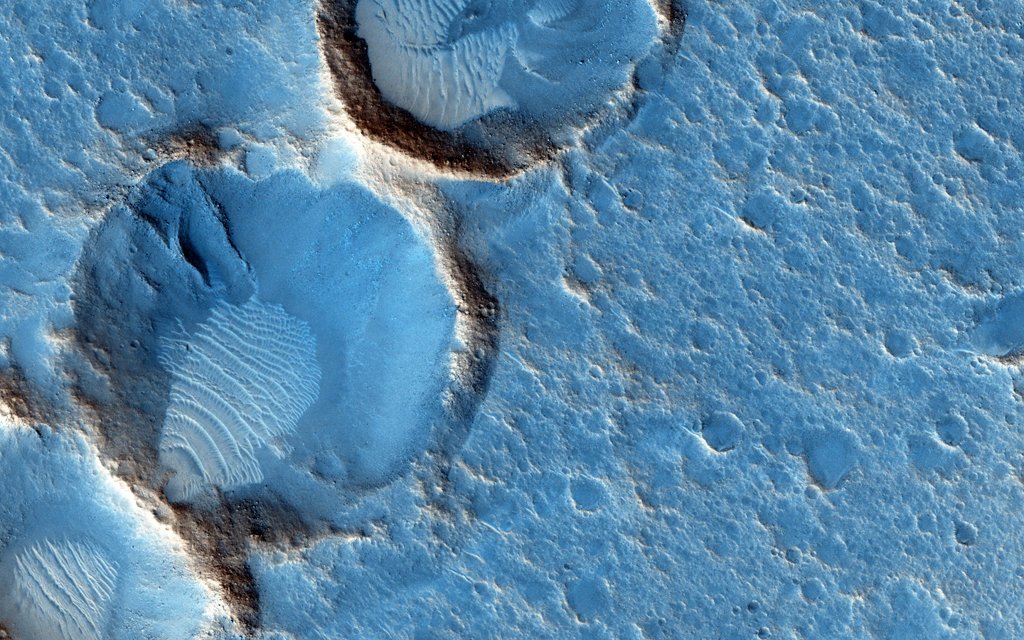
This close-up from the Mars Reconnaissance Orbiter’s HiRISE camera shows weathered craters and windblown deposits in southern Acidalia Planitia. A striking shade of blue in standard HiRISE image colors, to the human eye the area would probably look grey or a little reddish. But human eyes have not gazed across this terrain, unless you count the eyes of NASA astronauts in the scifi novel The Martian by Andy Weir. The novel chronicles the adventures of Mark Watney, an astronaut stranded at the fictional Mars mission Ares 3 landing site corresponding to the coordinates of this cropped HiRISE frame. For scale Watney’s 6-meter-diameter habitat at the site would be about 1/10th the diameter of the large crater. Of course, the Ares 3 landing coordinates are only about 800 kilometers north of the (real life) Carl Sagan Memorial Station, the 1997 Pathfinder landing site.

2024-03-23

Auteur/autrice

pelerinmarc@gmail.com

Publications similaires

Dans

Apollo 17 at Shorty Crater

Il y a cinquante-trois ans, en décembre 1972, les astronautes d’Apollo 17, Eugene Cernan et Harrison Schmitt, ont passé environ 75 heures...

Lire la suite
Dans

The Bipolar Jets of KX Andromedae

Jaillissant de l’étoile variable KX Andromède, ces stupéfiants jets bipolaires s’étendent sur 19 années-lumière. Récemment découverts, ils sont révélés avec un niveau...

Lire la suite
Dans

Galaxies in the Furnace

La galaxie elliptique géante NGC 1316, un exemple de violence à l’échelle cosmique, se situe à environ 75 millions d’années-lumière de nous,...

Lire la suite
Dans

Visualization: Near a Black Hole and Disk

À quoi ressemblerait une plongée dans un trou noir monstrueux ? Cette image issue d’une visualisation par superordinateur montre l’ensemble du ciel...

Lire la suite
Dans

M77: Spiral Galaxy with an Active Center

Que se passe-t-il au centre de la galaxie spirale voisine M77 ? Cette galaxie vue de face se trouve à seulement 47...

Lire la suite
Dans

3I ATLAS: Tails of an Interstellar Comet

Quelle est la typicalité de notre Système solaire ? L’étude de 3I/ATLAS, une comète de passage, fournit des indices. Les précédents visiteurs...

Lire la suite