×
Dans

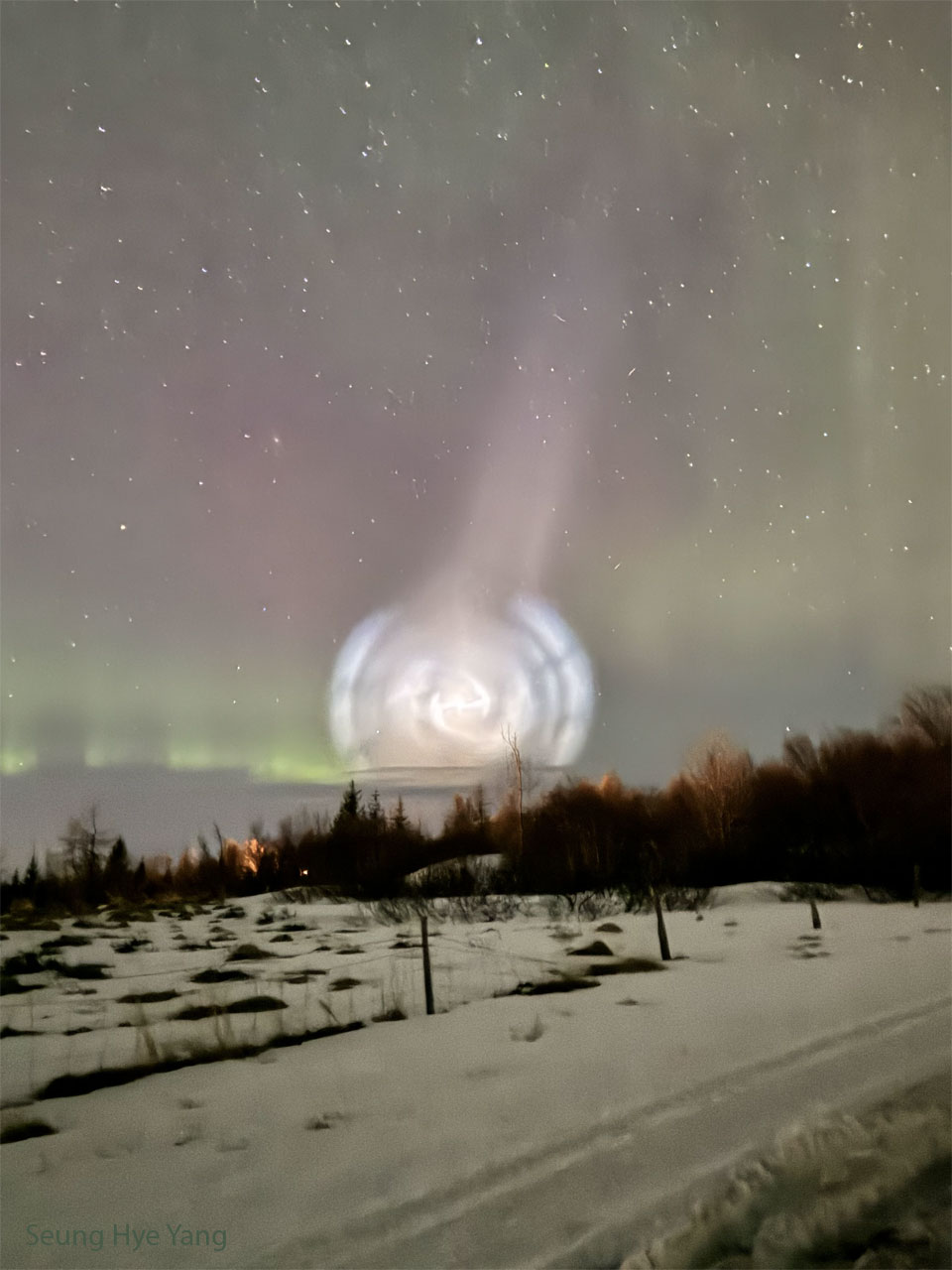
What’s that over the horizon? What may look like a strangely nearby galaxy is actually a normal rocket’s exhaust plume — but unusually backlit. Although the SpaceX Falcon 9 rocket was launched from Cape Canaveral in Florida, USA, its burned propellant was visible over a much wider area, with the featured photograph being taken from Akureyri, Iceland. The huge spaceship was lifted off a week ago, and the resulting spectacle was captured soon afterward with a single 10-second smartphone exposure, before it quickly dissipated. Like noctilucent clouds, the plume’s brightness is caused by the Twilight Effect, where an object is high enough to be illuminated by the twilight Sun, even when the observer on the ground experiences the darkness of night. The spiral shape is likely caused by high winds pushing the expelled gas into the shape of a corkscrew, which, when seen along the trajectory, looks like a spiral. Stars and faint green and red aurora appear in the background of this extraordinary image.

2024-03-12

Auteur/autrice

pelerinmarc@gmail.com

Publications similaires

Dans

NGC 2170: The Angel Nebula

Est-ce une peinture ou une photographie ? Dans cette œuvre d’art abstraite céleste composée avec un pinceau cosmique, la nébuleuse poussiéreuse NGC...

Lire la suite
Dans

NGC 1300: Barred Spiral Galaxy

Au centre de cette galaxie spirale se trouve une barre. Et au centre de cette barre se trouve une spirale plus petite....

Lire la suite
Dans

Aurora Slathers Up the Sky

Tel une salsa verde sur votre burrito préféré, une aurore verte nappe le ciel dans cette image du 25 juin 2017 prise...

Lire la suite
Dans

R3 PanSTARRS: An Orion Comet

La comète R3 PanSTARRS pourrait être mieux connue comme une comète d’Orion. Une raison principale est que la comète C/2025 R3 (PanSTARRS)...

Lire la suite
Dans

NGC 188: Old Cluster in the New General Catalogue

Le New General Catalogue of star clusters and nebulae n’est en réalité pas si nouveau. Il a été publié en 1888, fruit...

Lire la suite
Dans

NGC 188: Old Cluster in the New General Catalogue

Le « New General Catalog of Star Clusters and Nebulae » n’est en réalité pas si nouveau. Il a été publié en 1888, un...

Lire la suite