×
Dans

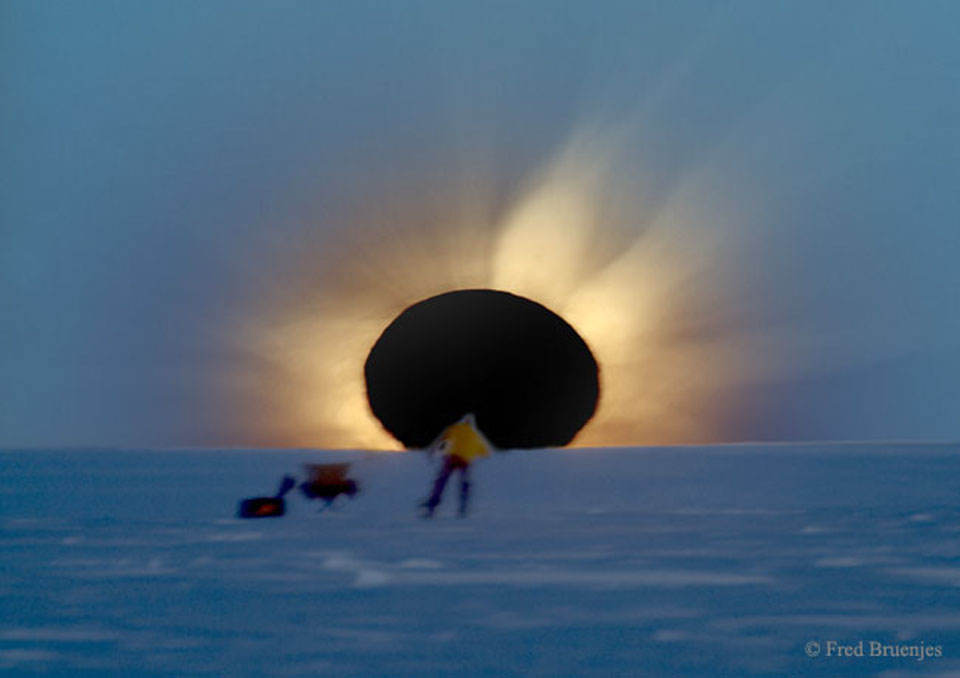
Would you go to the end of the world to see a total eclipse of the Sun? If you did, would you be surprised to find someone else there already? In 2003, the Sun, the Moon, Antarctica, and two photographers all lined up in Antarctica during an unusual total solar eclipse. Even given the extreme location, a group of enthusiastic eclipse chasers ventured near the bottom of the world to experience the surreal momentary disappearance of the Sun behind the Moon. One of the treasures collected was the featured picture — a composite of four separate images digitally combined to realistically simulate how the adaptive human eye saw the eclipse. As the image was taken, both the Moon and the Sun peeked together over an Antarctic ridge. In the sudden darkness, the magnificent corona of the Sun became visible around the Moon. Quite by accident, another photographer was caught in one of the images checking his video camera. Visible to his left are an equipment bag and a collapsible chair. A more easily visible solar eclipse will occur in just under four weeks and be visible from a long, thin swath of North America.

2024-03-10

Auteur/autrice

pelerinmarc@gmail.com

Publications similaires

Dans

Charon: Moon of Pluto

Une région polaire nord sombre et mystérieuse, connue de certains sous le nom de Mordor Macula, coiffe cette vue d’ensemble de Charon,...

Lire la suite
Dans

The Hydra Cluster of Galaxies

Dans notre propre galaxie, la Voie lactée, deux étoiles brillantes et piquantes se dressent comme des sentinelles au premier plan de cet...

Lire la suite
Dans

A Planetary Nebula with Cosmic Buckyballs

Que se passe-t-il à l’intérieur de cette nébuleuse inhabituelle ? La nébuleuse planétaire Tc 1, capturée ici dans un détail exquis par...

Lire la suite
Dans

Andromeda Through Gas and Dust

Il y a plus de 1000 ans, l’astronome perse Abd al-Rahman al-Sufi publiait dans « Le Livre des Étoiles Fixes » (Bibliothèque Bodléienne MS....

Lire la suite
Dans

The Vela Supernova Remnant

L’explosion est terminée, mais ses conséquences perdurent. Il y a environ douze mille ans, une étoile relativement normale de la constellation des...

Lire la suite
Dans

Eagle Nebula Pillars in Infrared from Hubble

Des étoiles nouvelles naissent dans la Nébuleuse de l’Aigle. Elles se contractent gravitationnellement dans des piliers de gaz dense et de poussière....

Lire la suite