×
Dans

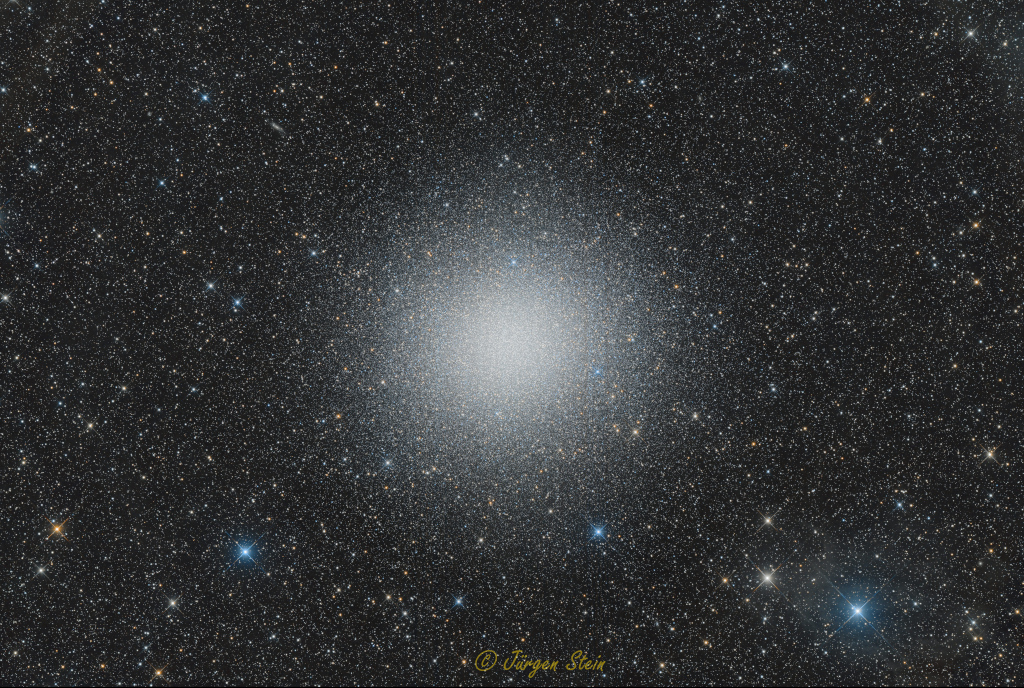
Globular star cluster Omega Centauri packs about 10 million stars much older than the Sun into a volume some 150 light-years in diameter. Also known as NGC 5139, at a distance of 15,000 light-years it’s the largest and brightest of 200 or so known globular clusters that roam the halo of our Milky Way galaxy. Though most star clusters consist of stars with the same age and composition, the enigmatic Omega Cen exhibits the presence of different stellar populations with a spread of ages and chemical abundances. In fact, Omega Cen may be the remnant core of a small galaxy merging with the Milky Way. With a yellowish hue, Omega Centauri’s red giant stars are easy to pick out in this sharp telescopic view. A two-decade-long exploration of the dense star cluster with the Hubble Space Telescope has revealed evidence for a massive black hole near the center of Omega Centauri.

2024-07-11

Auteur/autrice

marcpm@gmail.com

Publications similaires

Dans

Comet R3 PanSTARRS Before Rigel

Dans quelle direction va la comète R3 PanSTARRS ? Pas vers l’étoile en haut de l’image, car il s’agit de Rigel, qui,...

Lire la suite
Dans

The Retrograde Dance of Saturn and Neptune

Que signifie la rétrogradation de Saturne et Neptune ? La photo est un assemblage d’images prises sur 34 nuits entre mai 2025...

Lire la suite
Dans

Orion over Mount Teide

Orion est rarement visible ainsi. Pour obtenir cette majestueuse perspective, il faut un appareil photo capable de réaliser des expositions de si...

Lire la suite
Dans

Trifid Pillars and Jets

Les piliers de poussière sont comme des montagnes interstellaires. Ils survivent car ils sont plus denses que leur environnement, mais ils sont...

Lire la suite
Dans

Seeing Titan

Enveloppée dans une atmosphère épaisse, la surface de Titan, la plus grande lune de Saturne, est très difficile à observer. De petites...

Lire la suite
Dans

Markarian’s Chain

Près du cœur de l’amas de galaxies de la Vierge, une chaîne de galaxies connue sous le nom de Chaîne de Markarian...

Lire la suite