×
Dans

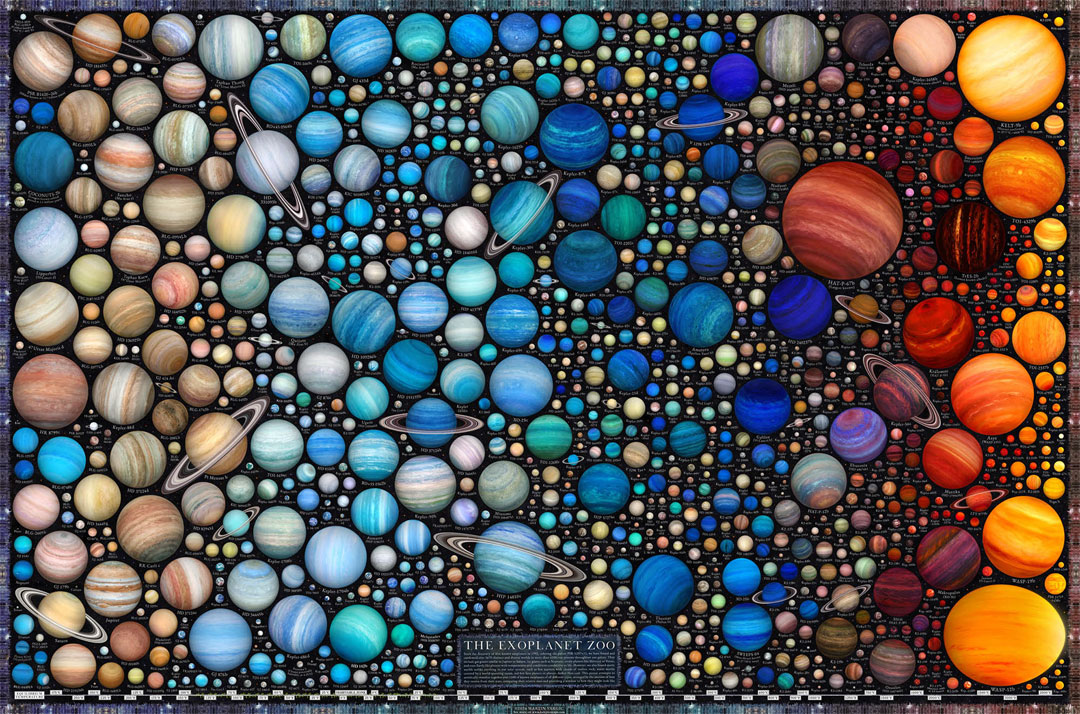
Do other stars have planets like our Sun? Surely they do, and evidence includes slight star wobbles created by the gravity of orbiting exoplanets and slight star dimmings caused by orbiting planets moving in front. In all, there have now been over 5,500 exoplanets discovered, including thousands by NASA’s space-based Kepler and TESS missions, and over 100 by ESO’s ground-based HARPS instrument. Featured here is an illustrated guess as to what some of these exoplanets might look like. Neptune-type planets occupy the middle and are colored blue because of blue-scattering atmospheric methane they might contain. On the sides of the illustration, Jupiter-type planets are shown, colored tan and red from the scatterings of atmospheric gases that likely include small amounts of carbon. Interspersed are many Earth-type rocky planets of many colors. As more exoplanets are discovered and investigated, humanity is developing a better understanding of how common Earth-like planets are, and how common life might be in the universe.

2024-07-08

Auteur/autrice

marcpm@gmail.com

Publications similaires

Dans

Messier Craters in Stereo

De nombreuses nébuleuses brillantes et amas d’étoiles dans le ciel de la Terre sont associés au nom de l’astronome Charles Messier, d’après...

Lire la suite
Dans

Comet R3 PanSTARRS Before Rigel

Dans quelle direction va la comète R3 PanSTARRS ? Pas vers l’étoile en haut de l’image, car il s’agit de Rigel, qui,...

Lire la suite
Dans

The Retrograde Dance of Saturn and Neptune

Que signifie la rétrogradation de Saturne et Neptune ? La photo est un assemblage d’images prises sur 34 nuits entre mai 2025...

Lire la suite
Dans

Orion over Mount Teide

Orion est rarement visible ainsi. Pour obtenir cette majestueuse perspective, il faut un appareil photo capable de réaliser des expositions de si...

Lire la suite
Dans

Trifid Pillars and Jets

Les piliers de poussière sont comme des montagnes interstellaires. Ils survivent car ils sont plus denses que leur environnement, mais ils sont...

Lire la suite
Dans

Seeing Titan

Enveloppée dans une atmosphère épaisse, la surface de Titan, la plus grande lune de Saturne, est très difficile à observer. De petites...

Lire la suite