×
Dans

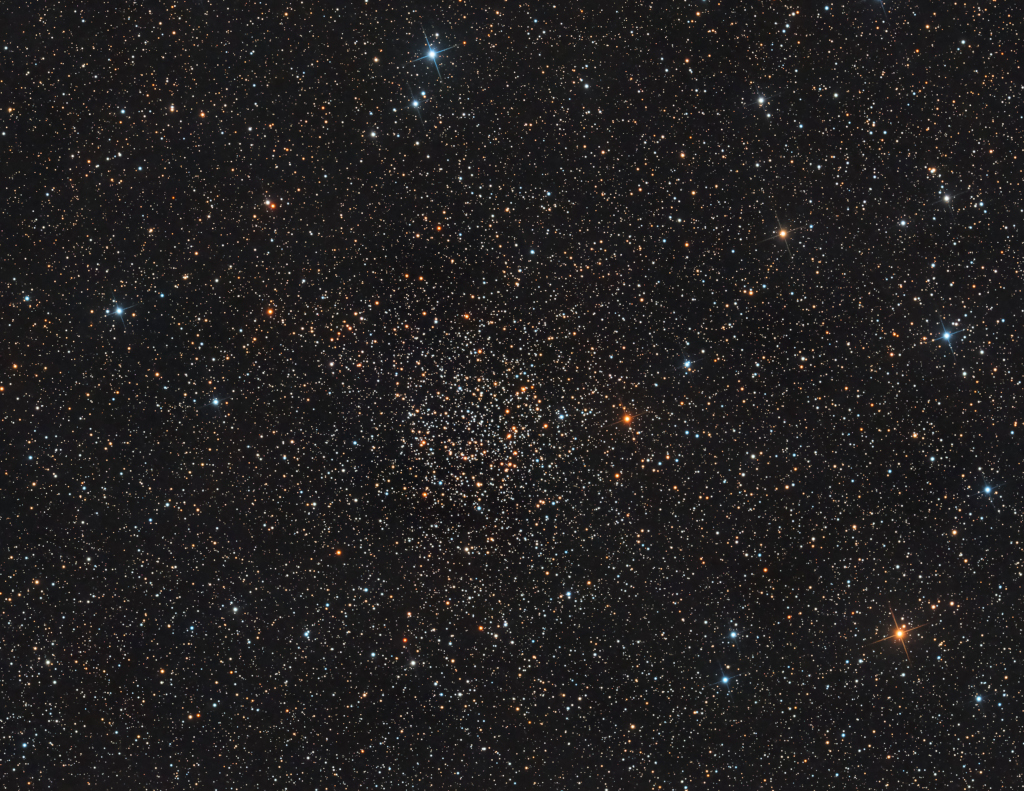
Found among the rich starfields of the Milky Way, star cluster NGC 7789 lies about 8,000 light-years away toward the constellation Cassiopeia. A late 18th century deep sky discovery of astronomer Caroline Lucretia Herschel, the cluster is also known as Caroline’s Rose. Its visual appearance in small telescopes, created by the cluster’s complex of stars and voids, is suggestive of nested rose petals. Now estimated to be 1.6 billion years young, the galactic or open cluster of stars also shows its age. All the stars in the cluster were likely born at the same time, but the brighter and more massive ones have more rapidly exhausted the hydrogen fuel in their cores. These have evolved from main sequence stars like the Sun into the many red giant stars shown with a yellowish cast in this color composite. Using measured color and brightness, astronomers can model the mass and hence the age of the cluster stars just starting to « turn off » the main sequence and become red giants. Over 50 light-years across, Caroline’s Rose spans about half a degree (the angular size of the Moon) near the center of the sharp telescopic image.

2024-07-06

Auteur/autrice

marcpm@gmail.com

Publications similaires

Dans

The Dark Wolf Nebula

Un loup noir repose dans le chewing-gum. Non, ce n’est pas une énigme ! L’image d’aujourd’hui présente la Nébuleuse du Loup Noir...

Lire la suite
Dans

NGC 2170: The Angel Nebula

Est-ce une peinture ou une photographie ? Dans cette œuvre d’art abstraite céleste composée avec un pinceau cosmique, la nébuleuse poussiéreuse NGC...

Lire la suite
Dans

NGC 1300: Barred Spiral Galaxy

Au centre de cette galaxie spirale se trouve une barre. Et au centre de cette barre se trouve une spirale plus petite....

Lire la suite
Dans

Aurora Slathers Up the Sky

Tel une salsa verde sur votre burrito préféré, une aurore verte nappe le ciel dans cette image du 25 juin 2017 prise...

Lire la suite
Dans

R3 PanSTARRS: An Orion Comet

La comète R3 PanSTARRS pourrait être mieux connue comme une comète d’Orion. Une raison principale est que la comète C/2025 R3 (PanSTARRS)...

Lire la suite
Dans

NGC 188: Old Cluster in the New General Catalogue

Le New General Catalogue of star clusters and nebulae n’est en réalité pas si nouveau. Il a été publié en 1888, fruit...

Lire la suite