×
Dans

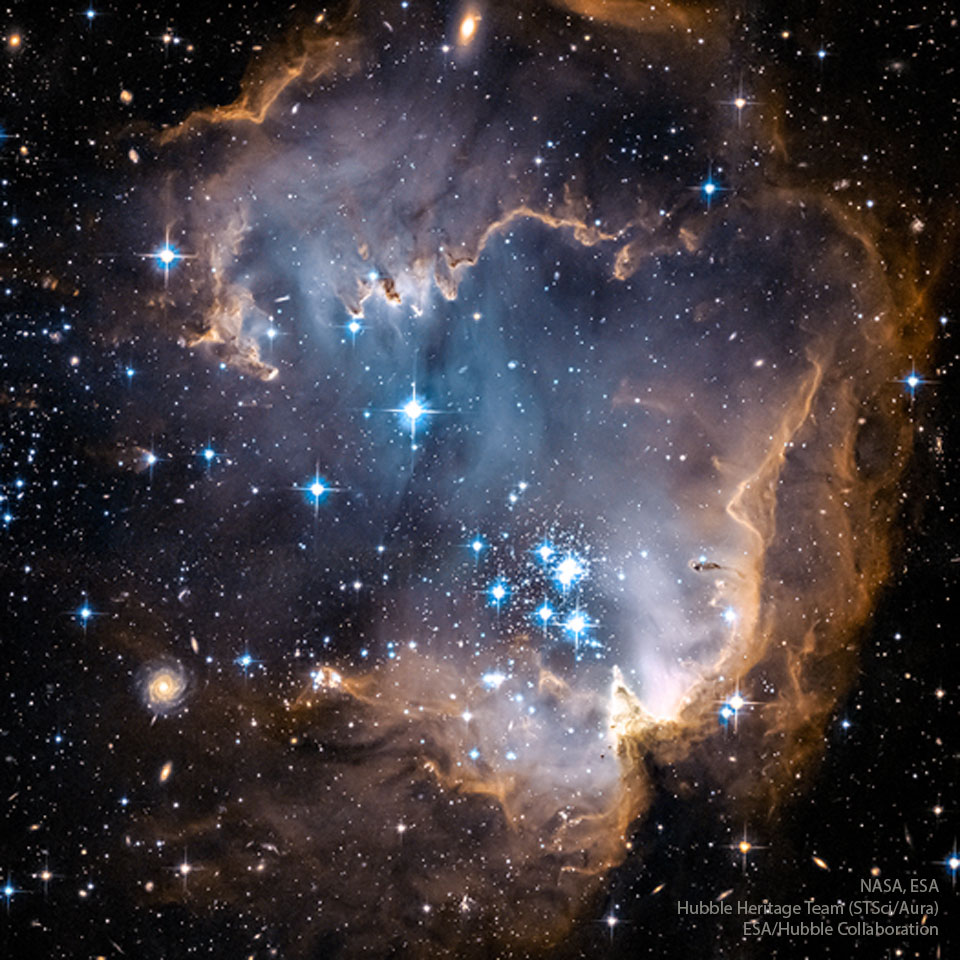
The clouds may look like an oyster, and the stars like pearls, but look beyond. Near the outskirts of the Small Magellanic Cloud, a satellite galaxy some 200 thousand light-years distant, lies this 5 million year old star cluster NGC 602. Surrounded by its birth shell of gas and dust, star cluster NGC 602 is featured in this stunning Hubble image, augmented in a rollover by images in the X-ray by the Chandra Observatory and in the infrared by Spitzer Telescope. Fantastic ridges and swept back gas strongly suggest that energetic radiation and shock waves from NGC 602’s massive young stars have eroded the dusty material and triggered a progression of star formation moving away from the star cluster’s center. At the estimated distance of the Small Magellanic Cloud, the featured picture spans about 200 light-years, but a tantalizing assortment of background galaxies are also visible in this sharp view. The background galaxies are hundreds of millions of light-years — or more — beyond NGC 602.

2024-07-02

Auteur/autrice

marco.pelerin@gmail.com

Publications similaires

Dans

IC 342: Hidden Galaxy in Camelopardalis

D’une taille similaire aux grandes et brillantes galaxies spirales de notre voisinage, IC 342 n’est qu’à 10 millions d’années-lumière, en direction de...

Lire la suite
Dans

Simeis 147: The Spaghetti Nebula Supernova Remnant

Son surnom populaire est la nébuleuse Spaghetti. Officiellement cataloguée comme Simeis 147 et Sharpless 2-240, il est facile de se perdre en...

Lire la suite
Dans

Jupiter’s Clouds in High Definition from Juno

La complexité de Jupiter : La mission Juno de la NASA révèle que la géante jovienne est plus compliquée que prévu. On...

Lire la suite
Dans

Full Moonlight

La Pleine Lune est la phase lunaire la plus brillante, et ce soir, vous pouvez vous baigner dans la lumière de la...

Lire la suite
Dans

NanoSail-D2

Le 20 janvier 2011, NanoSail-D2 de la NASA a déployé une voile de 10 mètres carrés, très fine et très réfléchissante, devenant...

Lire la suite
Dans

Auroral Corona

Le maximum du cycle solaire 25 a fait de 2025 une année exceptionnelle pour les aurores boréales (ou aurores australes) sur la...

Lire la suite