×
Dans

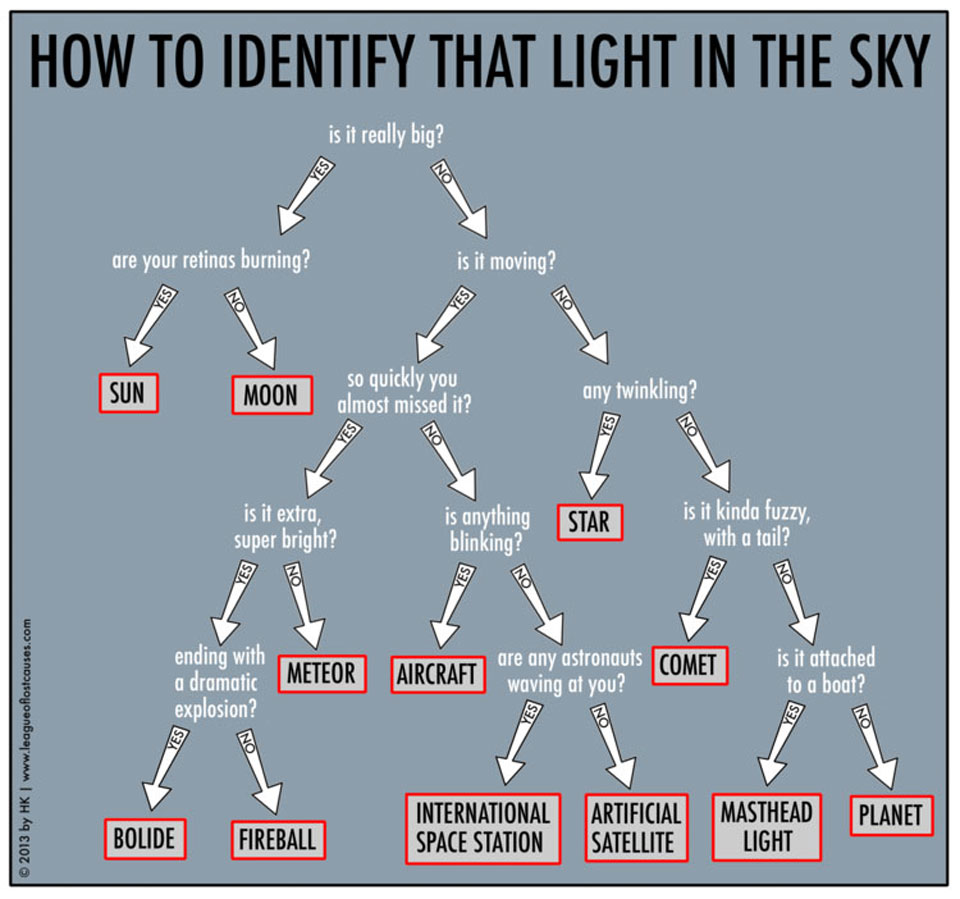
What is that light in the sky? The answer to one of humanity’s more common questions may emerge from a few quick observations. For example — is it moving or blinking? If so, and if you live near a city, the answer is typically an airplane, since planes are so numerous and so few stars and satellites are bright enough to be seen over the glare of artificial city lights. If not, and if you live far from a city, that bright light is likely a planet such as Venus or Mars — the former of which is constrained to appear near the horizon just before dawn or after dusk. Sometimes the low apparent motion of a distant airplane near the horizon makes it hard to tell from a bright planet, but even this can usually be discerned by the plane’s motion over a few minutes. Still unsure? The featured chart gives a sometimes-humorous but mostly-accurate assessment. Dedicated sky enthusiasts will likely note — and are encouraged to provide — polite corrections. Chart translations: Italian, German, Latvian, Persian, Polish, Spanish, and Turkish

2024-06-09

Auteur/autrice

pelerinmarc@gmail.com

Publications similaires

Dans

Black Holes and Neutron Stars: 218 Mergers and Counting

Quel est le son de la fusion de deux trous noirs dans l’espace profond ? Les ondes sonores ne se propagent pas...

Lire la suite
Dans

The Guardians of Rapa Nui beneath the Milky Way

Selon les mots de l’astrophotographe d’aujourd’hui, Rositsa Dimitrova, « Qu’ont vu ces sentinelles silencieuses traverser le ciel ? » Les mo’ai volcaniques (qui signifie...

Lire la suite
Dans

Light Pillars and Orion over Mohe

Que se passe-t-il au bout de cette rue ? Ce que l’on voit ici ne sont pas des aurores boréales, mais des...

Lire la suite
Dans

Leaving Earth

À quoi ressemblerait-on en quittant la planète Terre ? Un tel événement a été enregistré visuellement avec beaucoup de détails par la...

Lire la suite
Dans

Galaxies in the River: NGC 1300 and NGC 1297

La spirale NGC 1300 et l’elliptique NGC 1297 sont des galaxies situées sur les rives de la constellation australe de l’Éridan (Le...

Lire la suite
Dans

Spring Equinox at Teide Observatory

Le moment astronomique définissant l’équinoxe aujourd’hui est à 14h46 UTC (20 mars). C’est à ce moment que le Soleil traverse l’équateur céleste...

Lire la suite