×
Dans

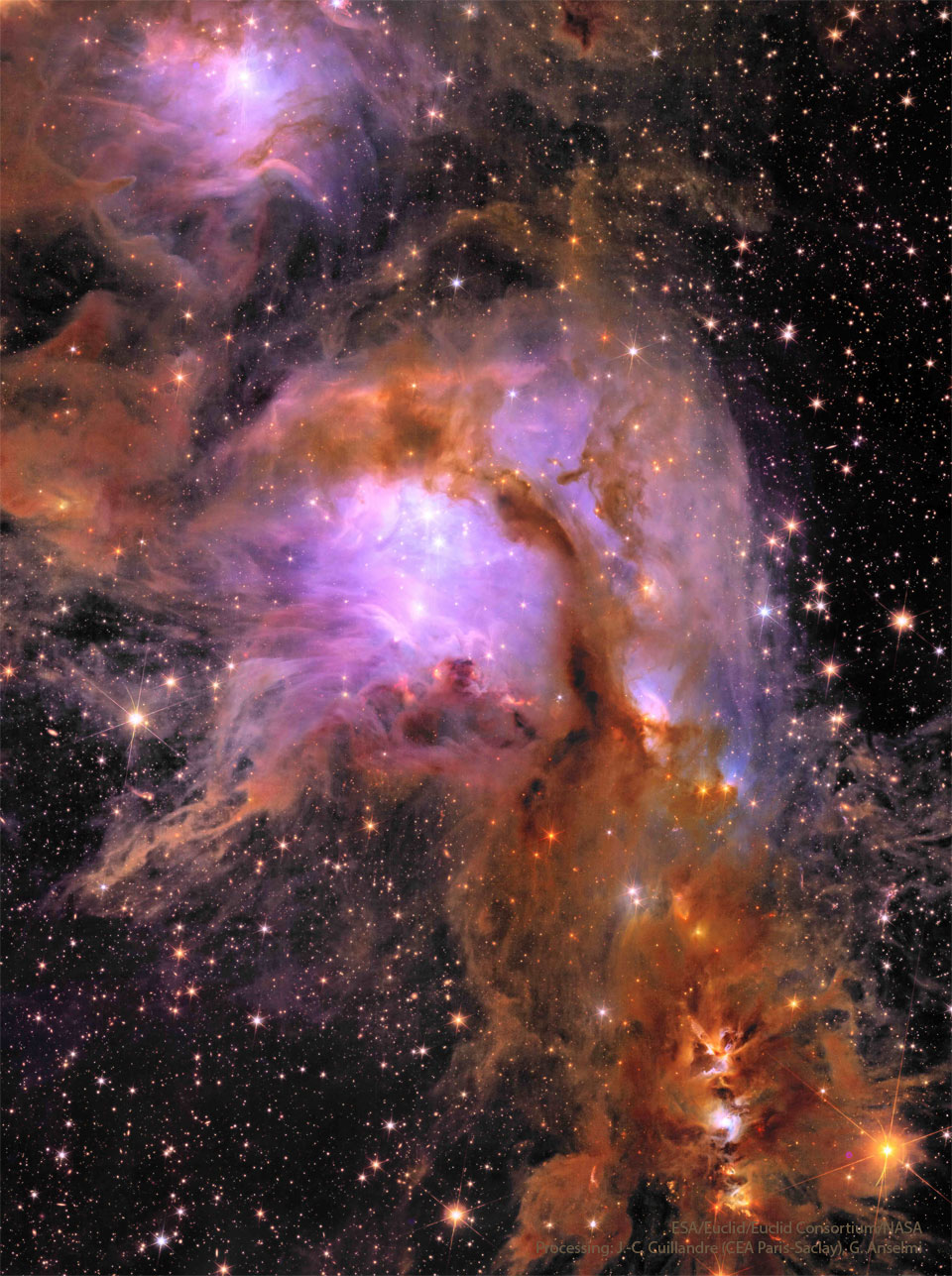
Star formation can be messy. To help find out just how messy, ESA’s new Sun-orbiting Euclid telescope recently captured the most detailed image ever of the bright star forming region M78. Near the image center, M78 lies at a distance of only about 1,300 light-years away and has a main glowing core that spans about 5 light-years. The featured image was taken in both visible and infrared light. The purple tint in M78’s center is caused by dark dust preferentially reflecting the blue light of hot, young stars. Complex dust lanes and filaments can be traced through this gorgeous and revealing skyscape. On the upper left is associated star forming region NGC 2071, while a third region of star formation is visible on the lower right. These nebulas are all part of the vast Orion Molecular Cloud Complex which can be found with even a small telescope just north of Orion’s belt. More Euclid Sky Candy: Recent images released from Euclid

2024-05-24

Auteur/autrice

pelerinmarc@gmail.com

Publications similaires

Dans

AR 4478: Giant Sunspot Group

Actuellement, l’un des plus grands groupes de taches solaires de l’histoire récente traverse le Soleil. La Région Active 4478 n’est pas seulement...

Lire la suite
Dans

Mars Marathon by Perseverance

Dans cette récente vue HiRISE de l’Orbiter de Reconnaissance de Mars, le petit point vert indiqué à la surface de la grande...

Lire la suite
Dans

Milky Way Urban Style

Dans une perspective cosmique que vous ne pourrez jamais voir, la Voie lactée s’arc-boute dans la nuit au-dessus de Séoul, en Corée...

Lire la suite
Dans

Anticrepuscular Rays over Sicily

Le Soleil vient de se coucher… à l’opposé du ciel. Sur cette image du plateau calcaire au cœur des montagnes Hybléennes, dans...

Lire la suite
Dans

Flying Past Neptune’s Moon Triton

À quoi ressemblerait un survol de Triton, la plus grande lune de la planète Neptune ? Un seul vaisseau spatial l’a fait...

Lire la suite
Dans

M27: The Dumbbell Nebula

Est-ce ainsi que notre Soleil finira ? Très probablement. Le premier indice de l’avenir de notre Soleil a été découvert par inadvertance...

Lire la suite