×
Dans

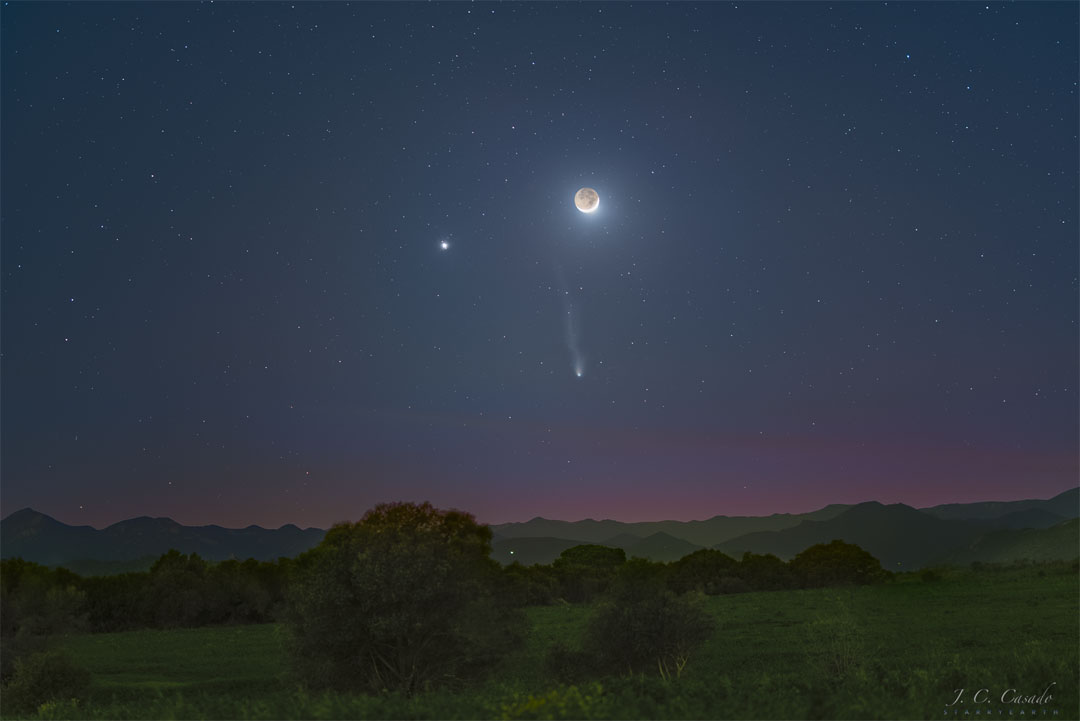
Three bright objects satisfied seasoned stargazers of the western sky just after sunset earlier this month. The most familiar was the Moon, seen on the upper left in a crescent phase. The rest of the Moon was faintly visible by sunlight first reflected by the Earth. The bright planet Jupiter, the largest planet in the Solar System, is seen to the upper left. Most unusual was Comet 12P/Pons-Brooks, below the Moon and showing a stubby dust tail on the right but an impressive ion tail extending upwards. The featured image, a composite of several images taken consecutively at the same location and with the same camera, was taken near the village of Llers, in Spain’s Girona province. Comet Pons-Brooks passed its closest to the Sun last week and is now dimming as it moves into southern skies and returns to the outer Solar System. Almost Hyperspace: Random APOD Generator

2024-04-29

Auteur/autrice

pelerinmarc@gmail.com

Publications similaires

Dans

Comet R3 PanSTARRS over a Himalayan Valley

La meilleure façon d’observer la longue queue de la comète R3 PanSTARRS est avec un appareil photo. Cette semaine, la comète récemment...

Lire la suite
Dans

Eye on the Milky Way

Avez-vous déjà eu des étoiles dans les yeux ? Il semble que l’œil de gauche en ait, et de plus, il semble...

Lire la suite
Dans

PanSTARRS and Planets

Près de l’horizon est avant le lever du soleil, la comète C/2025 R3 PanSTARRS devient plus brillante. Facilement visible aux jumelles et...

Lire la suite
Dans

M82: Starburst Galaxy with a Superwind

M82 est une galaxie à sursaut de formation d’étoiles, dotée d’un « supervent ». En effet, par le biais d’explosions de supernovae et de...

Lire la suite
Dans

South Celestial Tree

Si vous vivez dans l’hémisphère nord, vous avez peut-être appris à repérer l’étoile Polaire, Polaris, dans le ciel nocturne. Elle peut être...

Lire la suite
Dans

The Long Wispy Tail of Comet R3 (PanSTARRS)

Pourquoi la comète R3 (PanSTARRS) a-t-elle une queue vaporeuse ? Le plus récent membre brillant du système solaire interne, la comète C/2025...

Lire la suite