×
Dans

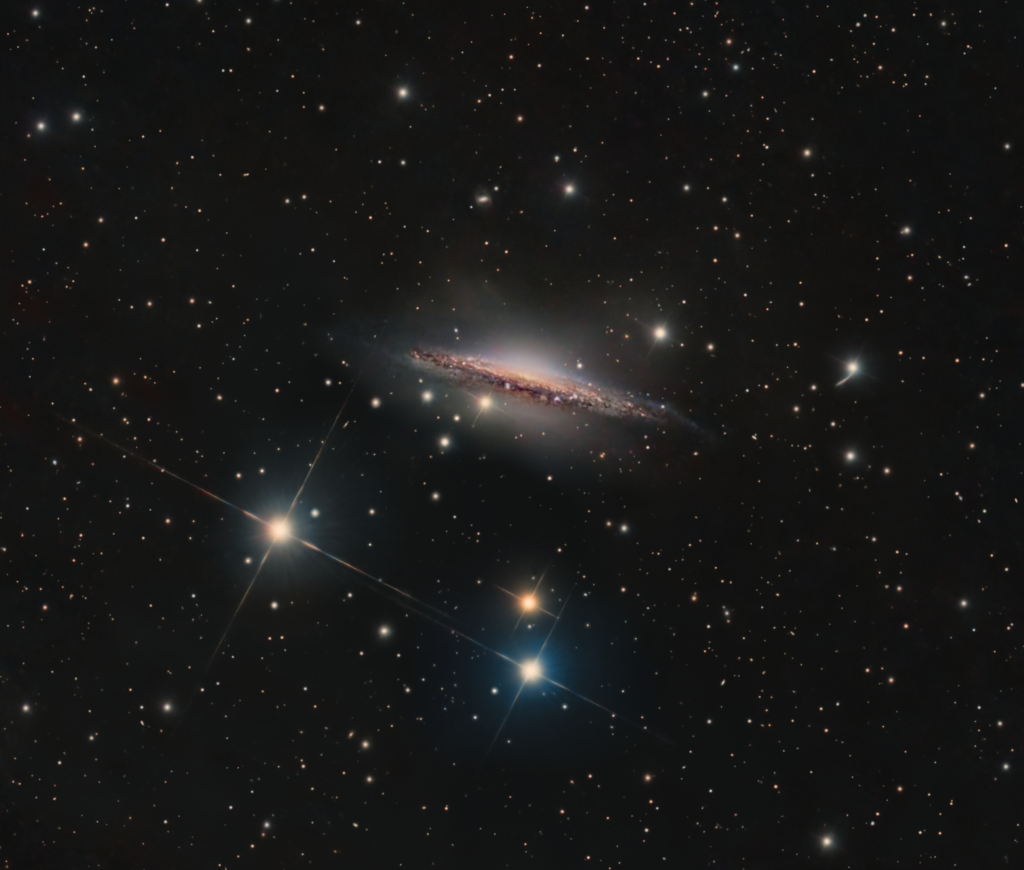
Big, beautiful spiral galaxy NGC 1055 is a dominant member of a small galaxy group a mere 60 million light-years away toward the aquatically intimidating constellation Cetus. Seen edge-on, the island universe spans over 100,000 light-years, a little larger than our own Milky Way galaxy. The colorful, spiky stars decorating this cosmic portrait of NGC 1055 are in the foreground, well within the Milky Way. But the telltale pinkish star forming regions are scattered through winding dust lanes along the distant galaxy’s thin disk. With a smattering of even more distant background galaxies, the deep image also reveals a boxy halo that extends far above and below the central bulge and disk of NGC 1055. The halo itself is laced with faint, narrow structures, and could represent the mixed and spread out debris from a satellite galaxy disrupted by the larger spiral some 10 billion years ago.

2024-03-15

Auteur/autrice

pelerinmarc@gmail.com

Publications similaires

Dans

R3 PanSTARRS: An Orion Comet

La comète R3 PanSTARRS pourrait être mieux connue comme une comète d’Orion. Une raison principale est que la comète C/2025 R3 (PanSTARRS)...

Lire la suite
Dans

NGC 188: Old Cluster in the New General Catalogue

Le New General Catalogue of star clusters and nebulae n’est en réalité pas si nouveau. Il a été publié en 1888, fruit...

Lire la suite
Dans

NGC 188: Old Cluster in the New General Catalogue

Le « New General Catalog of Star Clusters and Nebulae » n’est en réalité pas si nouveau. Il a été publié en 1888, un...

Lire la suite
Dans

The Conjunction of Comet R3 PanSTARRS and the Orion Nebula

L’image composite d’aujourd’hui présente quelque chose de vieux, quelque chose de neuf, quelque chose d’emprunté et quelque chose de bleu ! La...

Lire la suite
Dans

Moon Setting Behind Teide Volcano

Ces personnes ne sont pas en danger. Ce qui descend de la gauche n’est que la Lune, très loin à l’horizon. La...

Lire la suite
Dans

Comet R3 PanSTARRS and Orion

Orion n’avait jamais eu une épée pareille. Alors que la comète C/2025 R3 (PanSTARRS) quitte le système solaire interne, elle offre un...

Lire la suite