×
Dans

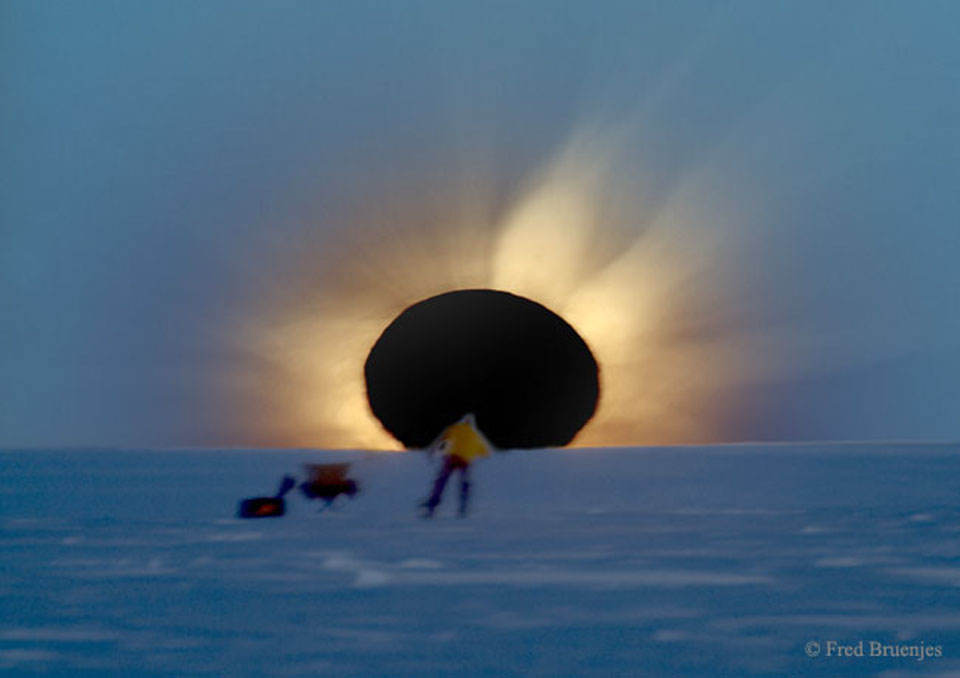
Would you go to the end of the world to see a total eclipse of the Sun? If you did, would you be surprised to find someone else there already? In 2003, the Sun, the Moon, Antarctica, and two photographers all lined up in Antarctica during an unusual total solar eclipse. Even given the extreme location, a group of enthusiastic eclipse chasers ventured near the bottom of the world to experience the surreal momentary disappearance of the Sun behind the Moon. One of the treasures collected was the featured picture — a composite of four separate images digitally combined to realistically simulate how the adaptive human eye saw the eclipse. As the image was taken, both the Moon and the Sun peeked together over an Antarctic ridge. In the sudden darkness, the magnificent corona of the Sun became visible around the Moon. Quite by accident, another photographer was caught in one of the images checking his video camera. Visible to his left are an equipment bag and a collapsible chair. A more easily visible solar eclipse will occur in just under four weeks and be visible from a long, thin swath of North America.

2024-03-10

Auteur/autrice

pelerinmarc@gmail.com

Publications similaires

Dans

NGC 2170: The Angel Nebula

Est-ce une peinture ou une photographie ? Dans cette œuvre d’art abstraite céleste composée avec un pinceau cosmique, la nébuleuse poussiéreuse NGC...

Lire la suite
Dans

NGC 1300: Barred Spiral Galaxy

Au centre de cette galaxie spirale se trouve une barre. Et au centre de cette barre se trouve une spirale plus petite....

Lire la suite
Dans

Aurora Slathers Up the Sky

Tel une salsa verde sur votre burrito préféré, une aurore verte nappe le ciel dans cette image du 25 juin 2017 prise...

Lire la suite
Dans

R3 PanSTARRS: An Orion Comet

La comète R3 PanSTARRS pourrait être mieux connue comme une comète d’Orion. Une raison principale est que la comète C/2025 R3 (PanSTARRS)...

Lire la suite
Dans

NGC 188: Old Cluster in the New General Catalogue

Le New General Catalogue of star clusters and nebulae n’est en réalité pas si nouveau. Il a été publié en 1888, fruit...

Lire la suite
Dans

NGC 188: Old Cluster in the New General Catalogue

Le « New General Catalog of Star Clusters and Nebulae » n’est en réalité pas si nouveau. Il a été publié en 1888, un...

Lire la suite