×
Dans

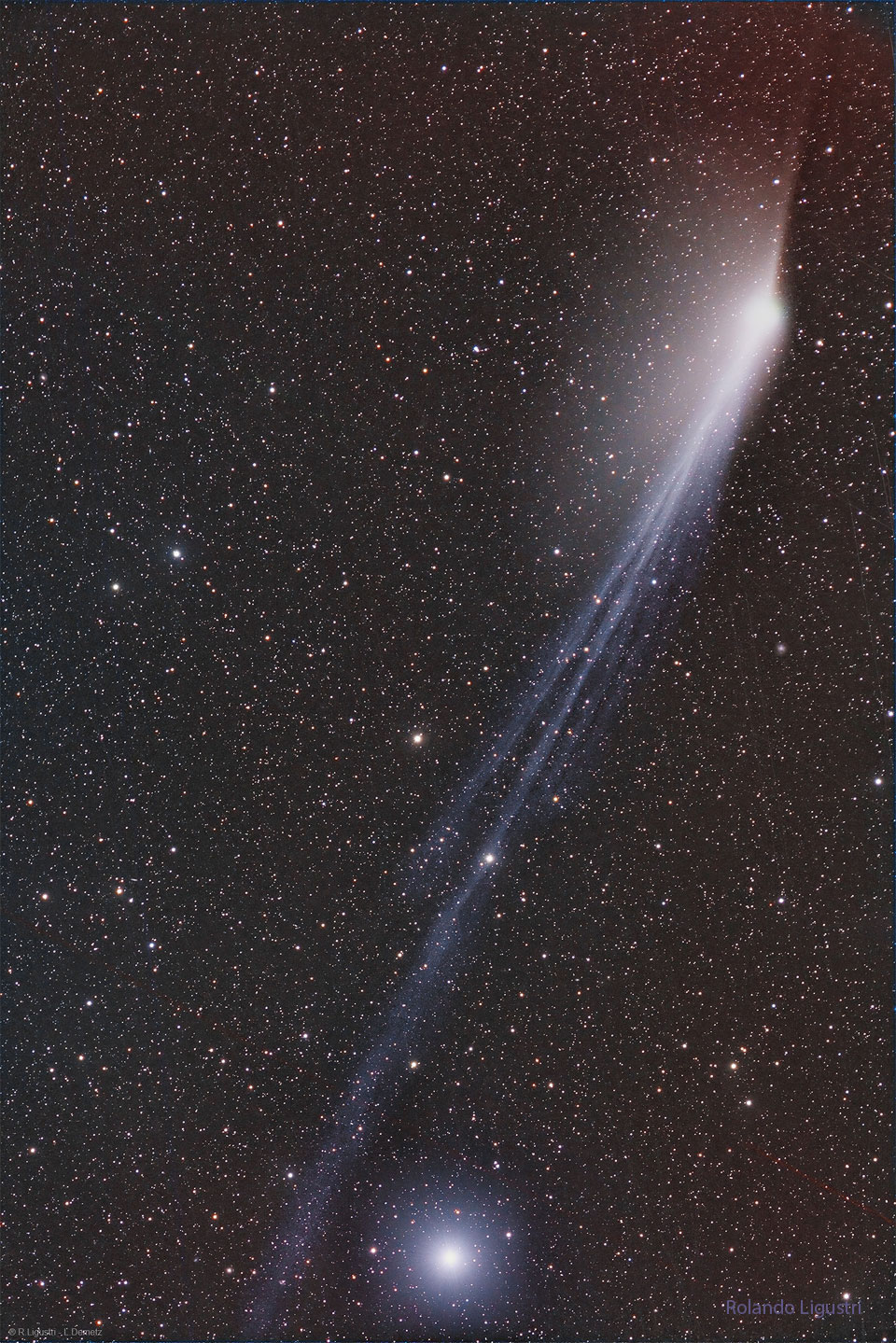
Why does Comet Pons-Brooks now have tails pointing in opposite directions? The most spectacular tail is the blue-glowing ion tail that is visible flowing down the image. The ion tail is pushed directly out from the Sun by the solar wind. On the upper right is the glowing central coma of Comet 12P/Pons–Brooks. Fanning out from the coma, mostly to the left, is the comet’s dust tail. Pushed out and slowed down by the pressure of sunlight, the dust tail tends to trail the comet along its orbit and, from some viewing angles, can appear opposite to the ion tail. The distant, bright star Alpha Leporis is seen at the bottom of the featured image captured last week from Namibia. Two days ago, the comet passed its closest to the Earth and is now best visible from southern skies as it dims and glides back to the outer Solar System.

2024-06-04

Auteur/autrice

pelerinmarc@gmail.com

Publications similaires

Dans

Orion over Mount Teide

Orion est rarement visible ainsi. Pour obtenir cette majestueuse perspective, il faut un appareil photo capable de réaliser des expositions de si...

Lire la suite
Dans

Trifid Pillars and Jets

Les piliers de poussière sont comme des montagnes interstellaires. Ils survivent car ils sont plus denses que leur environnement, mais ils sont...

Lire la suite
Dans

Seeing Titan

Enveloppée dans une atmosphère épaisse, la surface de Titan, la plus grande lune de Saturne, est très difficile à observer. De petites...

Lire la suite
Dans

Markarian’s Chain

Près du cœur de l’amas de galaxies de la Vierge, une chaîne de galaxies connue sous le nom de Chaîne de Markarian...

Lire la suite
Dans

Waves on Titan

Avez-vous déjà imaginé surfer sur un monde extraterrestre ? Nous pouvons désormais étendre la recherche de la vague parfaite de la Terre...

Lire la suite
Dans

The Moon, Venus, and the Pleiades

Non, la Terre n’a pas acquis récemment six lunes supplémentaires ! L’APOD d’aujourd’hui est une combinaison d’images suivant la Lune, Vénus et...

Lire la suite