×
Dans

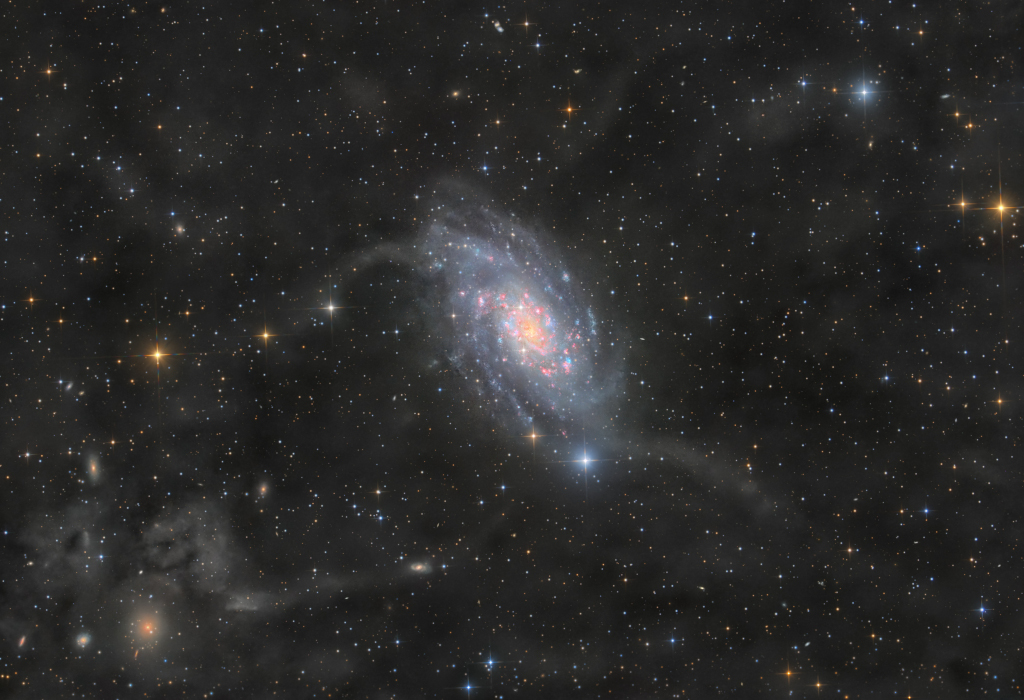
Magnificent island universe NGC 2403 stands within the boundaries of the long-necked constellation Camelopardalis. Some 10 million light-years distant and about 50,000 light-years across, the spiral galaxy also seems to have more than its fair share of giant star forming HII regions, marked by the telltale reddish glow of atomic hydrogen gas. The giant HII regions are energized by clusters of hot, massive stars that explode as bright supernovae at the end of their short and furious lives. A member of the M81 group of galaxies, NGC 2403 closely resembles a galaxy in our own local galaxy group with an abundance of star forming regions, M33, the Triangulum Galaxy. Spiky in appearance, bright stars in this portrait of NGC 2403 are in the foreground, within our own Milky Way. Also in the foreground of the deep, wide-field, telescopic image are the Milky Way’s dim and dusty interstellar clouds also known as galactic cirrus or integrated flux nebulae. But faint features that seem to extend from NGC 2403 itself are likely tidal stellar streams drawn out by gravitational interactions with neighboring galaxies.

2024-06-03

Auteur/autrice

pelerinmarc@gmail.com

Publications similaires

Dans

Perseids Over a little Planet

On dirait une vue de la planète du Petit Prince. L’image principale est un retour sur la pluie d’étoiles filantes des Perséides...

Lire la suite
Dans

Six Moons of Saturn

Combien de lunes compte Saturne ? Bien que le total continue probablement de croître, en juin 2026, le géant gazeux annelé comptait...

Lire la suite
Dans

Three Galaxy Pairs

Chacune de ces paires de galaxies est différente. Les deux galaxies du haut n’interagissent probablement pas, du moins pas actuellement. Cependant, la...

Lire la suite
Dans

Contemplating the Sun

Avez-vous contemplé votre étoile natale récemment ? Présenté ici, un Soleil partiellement éclipsé en haut à gauche par la Lune est également...

Lire la suite
Dans

A Messier Moment for Tempel 2

Lequel de ceux-ci n’est pas une comète ? Vous l’avez deviné – celui de droite est un amas globulaire d’étoiles. La coma...

Lire la suite
Dans

Rubin’s COSMOS field

Plus d’un demi-million de galaxies peuplent le panneau central de cette image provenant de l’Observatoire Vera C. Rubin de la NSF-DOE au...

Lire la suite