×
Dans

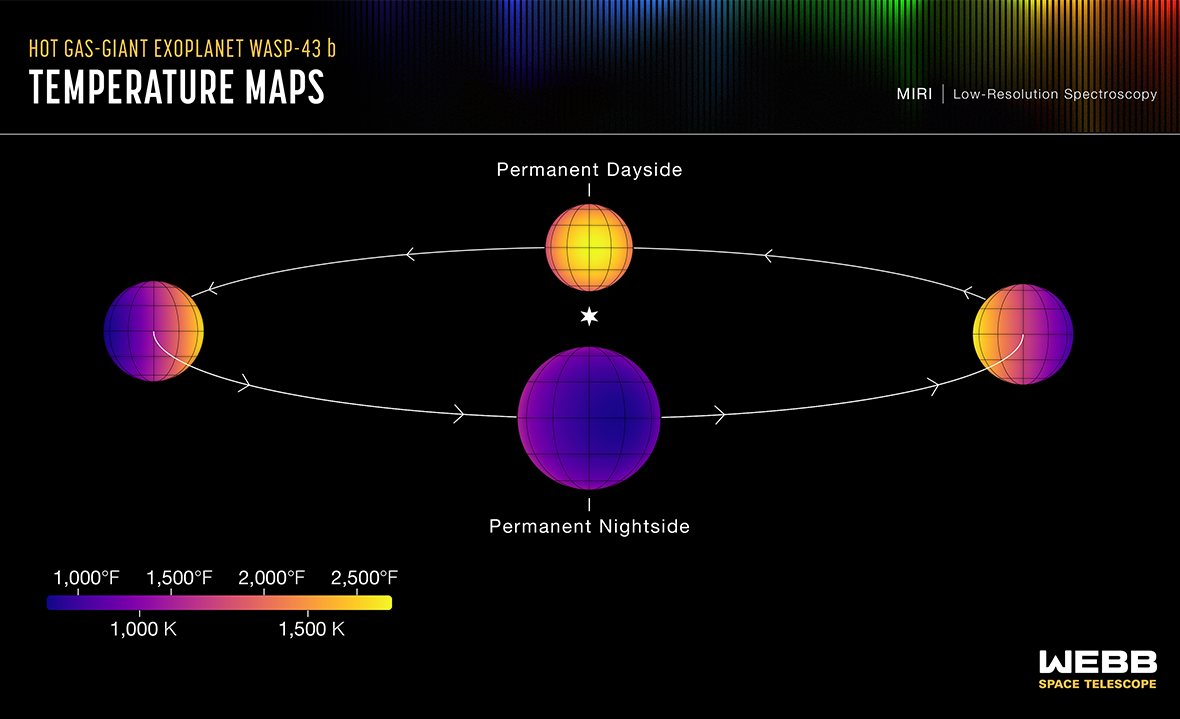
A mere 280 light-years from Earth, tidally locked, Jupiter-sized exoplanet WASP-43b orbits its parent star once every 0.8 Earth days. That puts it about 2 million kilometers (less than 1/25th the orbital distance of Mercury) from a small, cool sun. Still, on a dayside always facing its parent star, temperatures approach a torrid 2,500 degrees F as measured at infrared wavelengths by the MIRI instrument on board the James Webb Space Telescope. In this illustration of the hot exoplanet’s orbit, Webb measurements also show nightside temperatures remain above 1,000 degrees F. That suggests that strong equatorial winds circulate the dayside atmospheric gases to the nightside before they can completely cool off. Exoplanet WASP-43b is now formally known as Astrolábos, and its K-type parent star has been christened Gnomon. Webb’s infrared spectra indicate water vapor is present on the nightside as well as the dayside of the planet, providing information about cloud cover on Astrolábos.

2024-05-03

Auteur/autrice

pelerinmarc@gmail.com

Publications similaires

Dans

The Dusty Surroundings of Orion and the Pleiades

Que savez-vous du ciel nocturne ? D’accord, mais dans quelle mesure pouvez-vous identifier des objets célestes célèbres dans une image très profonde...

Lire la suite
Dans

Lunar Occultation of Mercury

Les amateurs du ciel occidental après le coucher du soleil ont récemment pu admirer l’étonnant alignement de planètes brillantes ce mois-ci. Observé...

Lire la suite
Dans

Sharpless 249 and the Jellyfish Nebula

Normalement faible et insaisissable, la nébuleuse de la Méduse est capturée dans ce champ de vision télescopique captivant. Flottant dans la mer...

Lire la suite
Dans

Webb and Hubble: IC 5332

À quoi ressemble l’univers à travers des lunettes infrarouges ? Nos yeux ne peuvent voir que la lumière visible, mais les astronomes...

Lire la suite
Dans

Planet Parade over Sydney Opera House

Regardez le ciel cette semaine et vous verrez une multitude de planètes. Juste après le coucher du soleil, en regardant vers l’ouest...

Lire la suite
Dans

Pleiades: The Seven Sisters Star Cluster

Avez-vous déjà vu l’amas d’étoiles des Pléiades ? Même si c’est le cas, vous ne l’avez probablement jamais vu aussi grand et...

Lire la suite