×
Dans

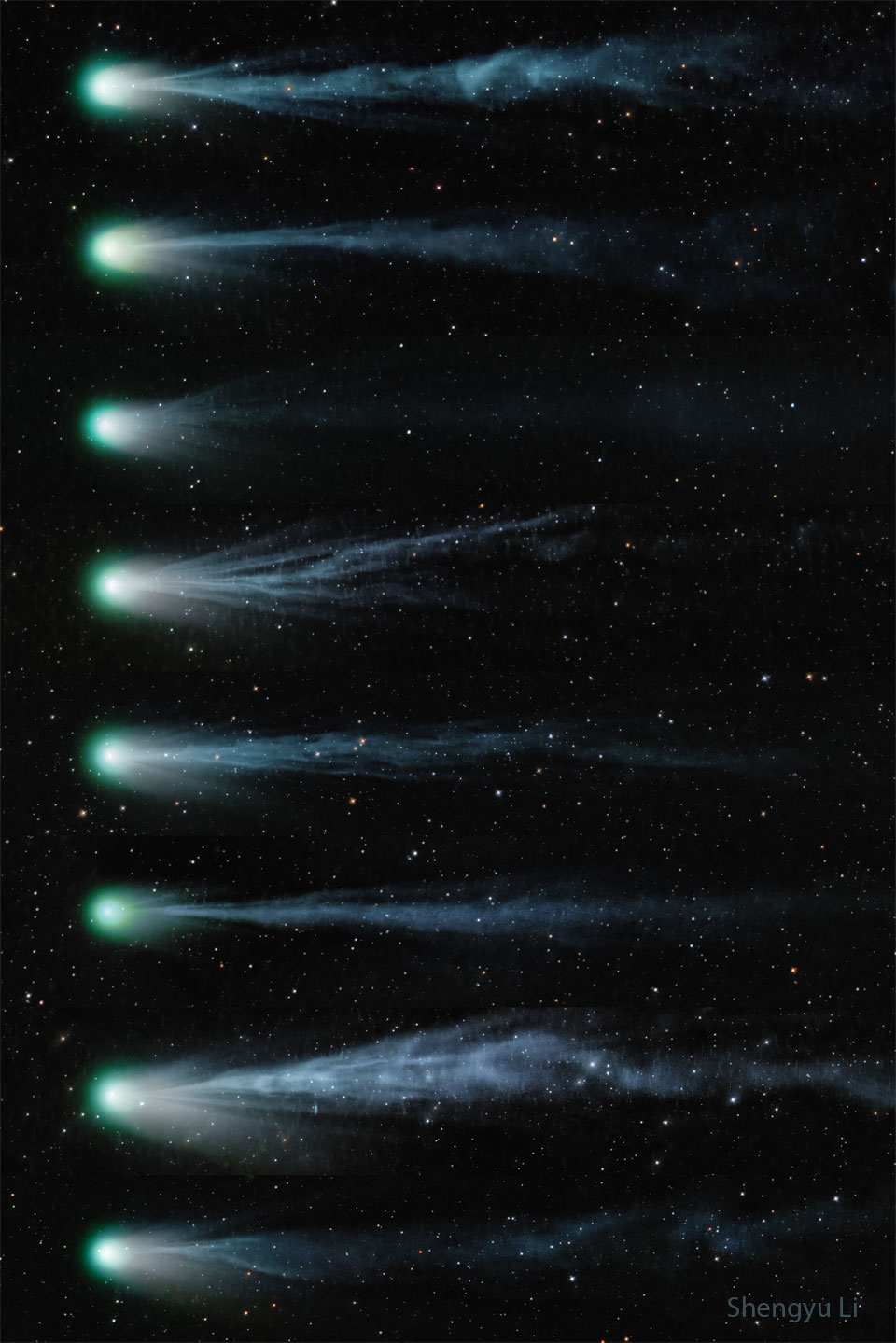
How does a comet tail change? It depends on the comet. The ion tail of Comet 12P/Pons–Brooks has been changing markedly, as detailed in the featured image sequenced over nine days from March 6 to 14 (top to bottom). On some days, the comet’s ion tail was relatively long and complex, but not every day. Reasons for tail changes include the rate of ejection of material from the comet’s nucleus, the strength and complexity of the passing solar wind, and the rotation rate of the comet. Over the course of a week, apparent changes even include a change of perspective from the Earth. In general, a comet’s ion tail will point away from the Sun, as gas expelled is pushed out by the Sun’s wind. Today, Pons-Brooks may become a rare comet suddenly visible in the middle of the day for those able to see the Sun totally eclipsed by the Moon. NASA Coverage: Today’s Total Solar Eclipse Total Eclipse Imagery: Notable Submissions to APOD

2024-04-08

Auteur/autrice

pelerinmarc@gmail.com

Publications similaires

Dans

Messier 24: Sagittarius Star Cloud

Contrairement à la plupart des objets du célèbre catalogue de Charles Messier, M24 n’est pas une galaxie brillante, un amas d’étoiles ou...

Lire la suite
Dans

Western Moon, Eastern Sea

La Mare Orientale, qui signifie « Mer Orientale » en latin, est l’une des plus frappantes formations lunaires à grande échelle. C’est le plus...

Lire la suite
Dans

The Red Glow of the Cosmic Bat Nebula

La Chauve-souris Cosmique te souhaite un joyeux « Summerween » ! Cette célébration à mi-année d’Halloween transcende les hémisphères, même si l’été dans l’hémisphère...

Lire la suite
Dans

Swift Boost Mission

Parfois, nous avons tous besoin d’un petit coup de pouce d’un ami. L’observatoire Neil Gehrels Swift de la NASA a besoin d’un...

Lire la suite
Dans

NGC 6188: Dragons of Ara

Où peut-on voir des dragons se battre dans le ciel nocturne ? Dans la constellation australe de l’Autel : Ara. Les dragons...

Lire la suite
Dans

Dueling Bands over the Atacama Desert

Quels sont ces deux bandes dans le ciel ? La bande la plus couramment vue est à gauche et est la bande...

Lire la suite