×
Dans

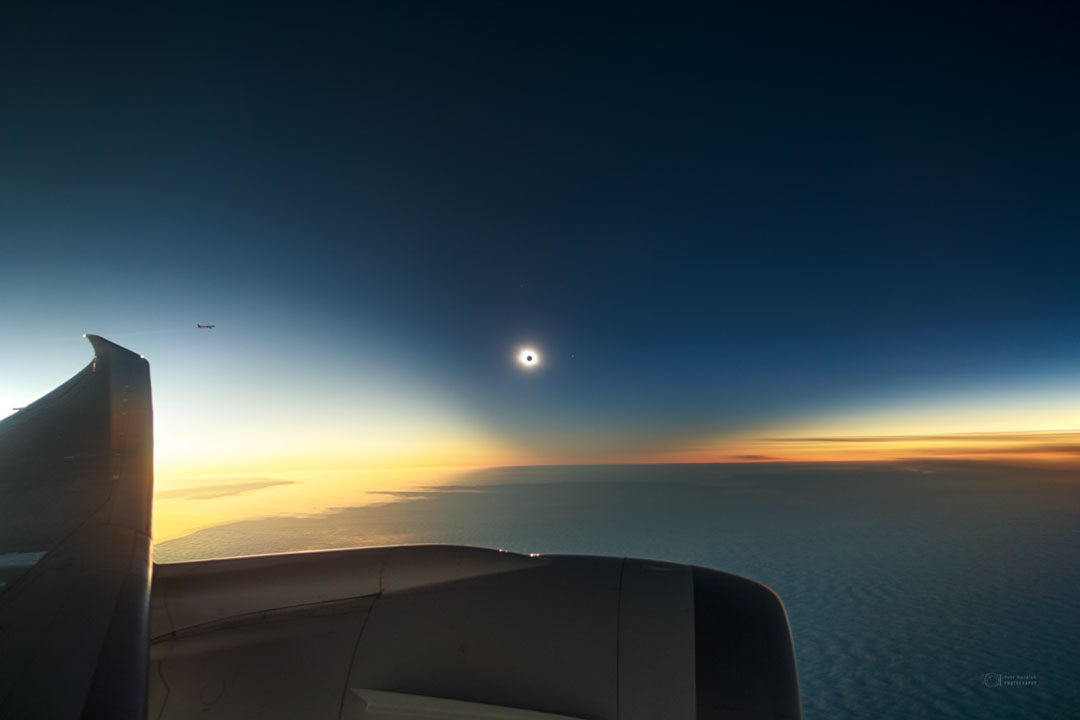
In late 2021 there was a total solar eclipse visible only at the end of the Earth. To capture the unusual phenomenon, airplanes took flight below the clouded seascape of Southern Ocean. The featured image shows one relatively spectacular capture where the bright spot is the outer corona of the Sun and the eclipsing Moon is seen as the dark spot in the center. A wing and engine of the airplane are visible across the left and bottom of the image, while another airplane observing the eclipse is visible on the far left. The dark area of the sky surrounding the eclipsed Sun is called a shadow cone. It is dark because you are looking down a long corridor of air shadowed by the Moon. A careful inspection of the eclipsed Sun will reveal the planet Mercury just to the right. You won’t have to travel to the end of the Earth to see the next total solar eclipse. The total eclipse path will cross North America on 2024 April 8, just over one week from today. NASA Coverage: Total Solar Eclipse of 2024 April 8

2024-03-31

Auteur/autrice

pelerinmarc@gmail.com

Publications similaires

Dans

NGC 188: Old Cluster in the New General Catalogue

Le New General Catalogue of star clusters and nebulae n’est en réalité pas si nouveau. Il a été publié en 1888, fruit...

Lire la suite
Dans

NGC 188: Old Cluster in the New General Catalogue

Le « New General Catalog of Star Clusters and Nebulae » n’est en réalité pas si nouveau. Il a été publié en 1888, un...

Lire la suite
Dans

The Conjunction of Comet R3 PanSTARRS and the Orion Nebula

L’image composite d’aujourd’hui présente quelque chose de vieux, quelque chose de neuf, quelque chose d’emprunté et quelque chose de bleu ! La...

Lire la suite
Dans

Moon Setting Behind Teide Volcano

Ces personnes ne sont pas en danger. Ce qui descend de la gauche n’est que la Lune, très loin à l’horizon. La...

Lire la suite
Dans

Comet R3 PanSTARRS and Orion

Orion n’avait jamais eu une épée pareille. Alors que la comète C/2025 R3 (PanSTARRS) quitte le système solaire interne, elle offre un...

Lire la suite
Dans

Messier Craters in Stereo

De nombreuses nébuleuses brillantes et amas d’étoiles dans le ciel de la Terre sont associés au nom de l’astronome Charles Messier, d’après...

Lire la suite