×
Dans

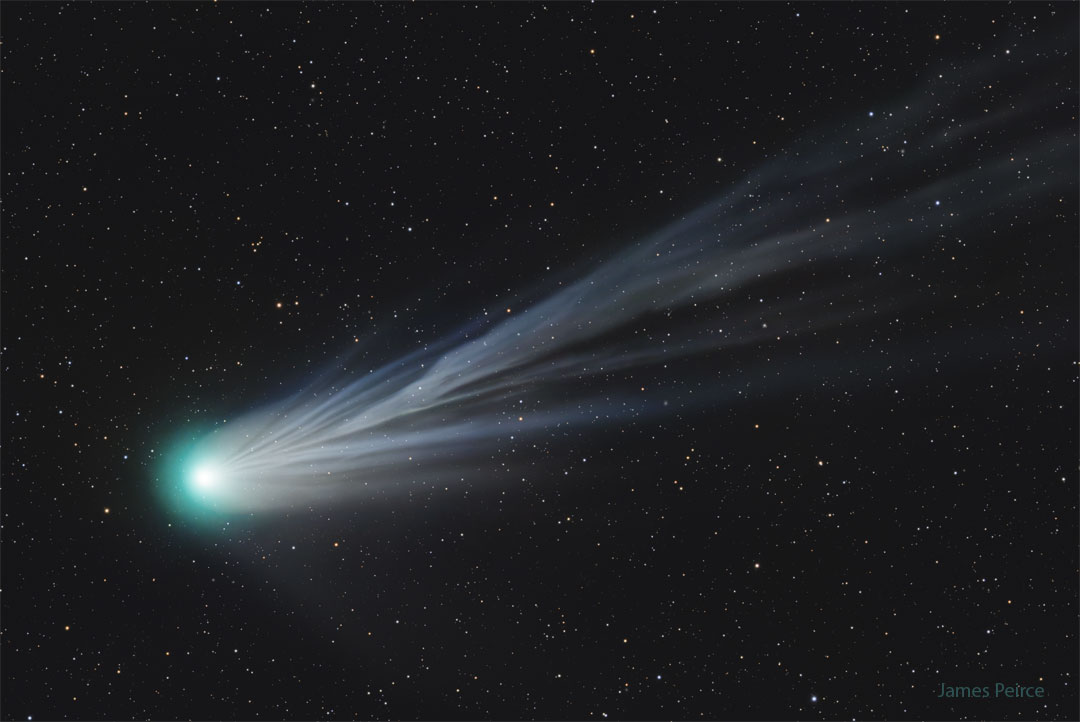
Comet Pons-Brooks has quite a tail to tell. First discovered in 1385, this erupting dirty snowball loops back into our inner Solar System every 71 years and, this time, is starting to put on a show for deep camera exposures. In the featured picture, the light blue stream is the ion tail which consists of charged molecules pushed away from the comet’s nucleus by the solar wind. The ion tail, shaped by the Sun’s wind and the comet’s core’s rotation, always points away from the Sun. Comet 12P/Pons–Brooks is now visible with binoculars in the early evening sky toward the northwest, moving perceptibly from night to night. The frequently flaring comet is expected to continue to brighten, on the average, and may even become visible with the unaided eye — during the day — to those in the path of totality of the coming solar eclipse on April 8.

2024-03-26

Auteur/autrice

pelerinmarc@gmail.com

Publications similaires

Dans

Flying Past Neptune’s Moon Triton

À quoi ressemblerait un survol de Triton, la plus grande lune de la planète Neptune ? Un seul vaisseau spatial l’a fait...

Lire la suite
Dans

M27: The Dumbbell Nebula

Est-ce ainsi que notre Soleil finira ? Très probablement. Le premier indice de l’avenir de notre Soleil a été découvert par inadvertance...

Lire la suite
Dans

Keogram: The Sky in 2025

Et si vous pouviez voir le ciel entier — d’un seul coup — pendant une année entière ? C’est, à peu de...

Lire la suite
Dans

Daytime Moon Meets Evening Star

Vénus apparaît désormais sur la scène céleste comme la brillante étoile du soir de la Terre, se produisant aux côtés de la...

Lire la suite
Dans

Starry Night II

Cette scène vous semble-t-elle familière ? Il s’agit d’une recréation moderne du célèbre tableau La Nuit étoilée de Vincent van Gogh. L’image...

Lire la suite
Dans

Longmore 8: The Hamster Wheel Nebula

Comment une roue de hamster s’est-elle retrouvée dans l’espace ? La nébuleuse de la Roue de Hamster (Longmore 8) a été découverte...

Lire la suite