×
Dans

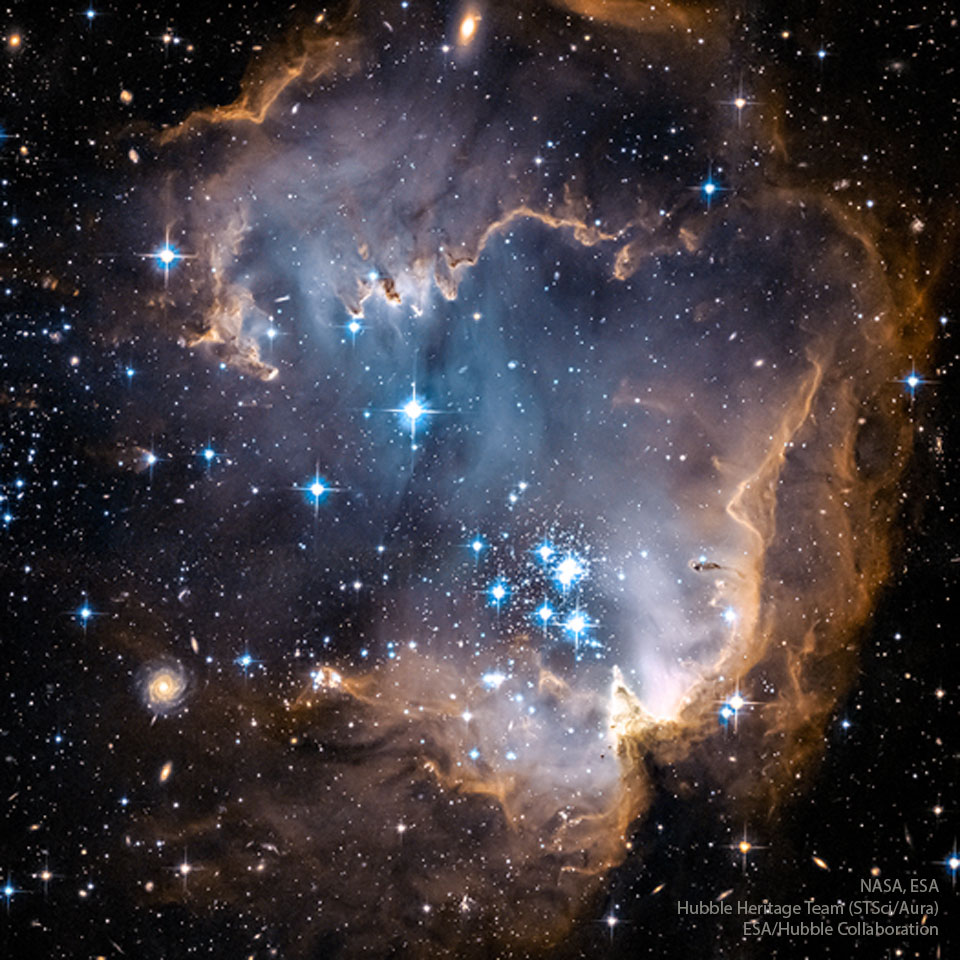
The clouds may look like an oyster, and the stars like pearls, but look beyond. Near the outskirts of the Small Magellanic Cloud, a satellite galaxy some 200 thousand light-years distant, lies this 5 million year old star cluster NGC 602. Surrounded by its birth shell of gas and dust, star cluster NGC 602 is featured in this stunning Hubble image, augmented in a rollover by images in the X-ray by the Chandra Observatory and in the infrared by Spitzer Telescope. Fantastic ridges and swept back gas strongly suggest that energetic radiation and shock waves from NGC 602’s massive young stars have eroded the dusty material and triggered a progression of star formation moving away from the star cluster’s center. At the estimated distance of the Small Magellanic Cloud, the featured picture spans about 200 light-years, but a tantalizing assortment of background galaxies are also visible in this sharp view. The background galaxies are hundreds of millions of light-years — or more — beyond NGC 602.

2024-07-02

Auteur/autrice

marcpm@gmail.com

Publications similaires

Dans

Supermoon Versus Micromoon

Qu’y a-t-il de si micro dans la microm Lüne bleue de ce soir ? Juste après le coucher du soleil, une pleine...

Lire la suite
Dans

Messier 104

Une magnifique galaxie spirale, Messier 104 est célèbre pour son profil quasi de profil, caractérisé par un large anneau de bandes de...

Lire la suite
Dans

NGC 1514: The Crystal Ball Nebula

Que voyez-vous dans cette boule de cristal ? L’image présentée montre NGC 1514, connue sous le nom de nébuleuse de la Boule...

Lire la suite
Dans

PK 164 +31.1: The Headphone Nebula

Que fait une paire d’écouteurs dans le ciel ? L’image du jour présente la Nébuleuse des Écouteurs, également connue sous le nom...

Lire la suite
Dans

NGC 3660 and Burçin’s Galaxy

La galaxie du haut est peut-être plus photogénique, mais la galaxie du bas est plus inhabituelle. La galaxie en haut est NGC...

Lire la suite
Dans

Thackeray’s Globules

Que sont ces étranges globes spatiaux ? Situés dans de riches champs stellaires et du gaz d’hydrogène incandescent, ces nuages opaques de...

Lire la suite