×
Dans

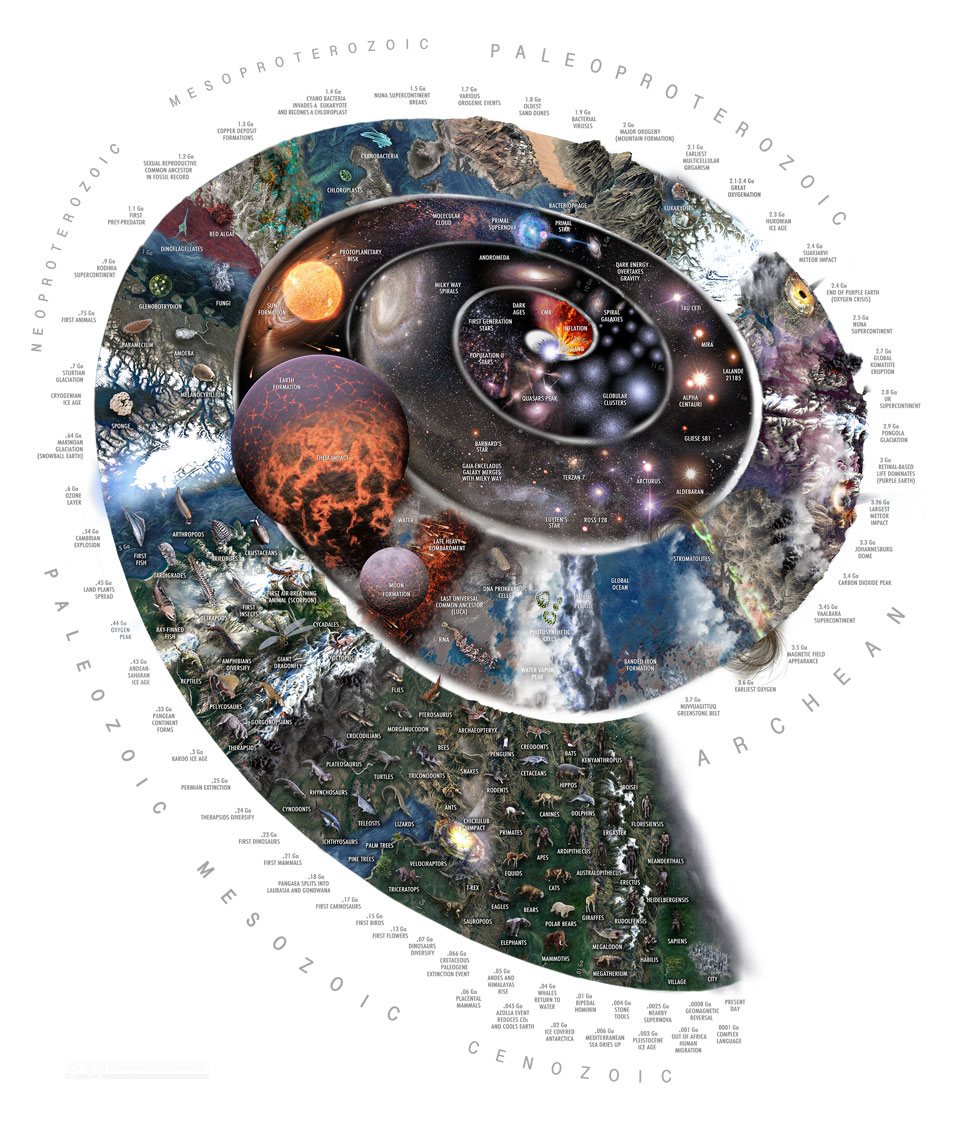
What’s happened since the universe started? The time spiral shown here features a few notable highlights. At the spiral’s center is the Big Bang, the place where time, as we know it, began about 13.8 billion years ago. Within a few billion years atoms formed, then stars formed from atoms, galaxies formed from stars and gas, our Sun formed, soon followed by our Earth, about 4.6 billion years ago. Life on Earth begins about 3.8 billion years ago, followed by cells, then photosynthesis within a billion years. About 1.7 billion years ago, multicellular life on Earth began to flourish. Fish began to swim about 500 million years ago, and mammals because walking on land about 200 million years ago. Humans first appeared only about 6 million years ago, and made the first cities only about 10,000 years ago. The time spiral illustrated stops there, but human spaceflight might be added, which started only 75 years ago, and useful artificial intelligence began to take hold within only the past few years. Explore Your Universe: Random APOD Generator

2024-07-01

Auteur/autrice

marco.pelerin@gmail.com

Publications similaires

Dans

Gemini Meteors over Snow Capped Mountains

D’où proviennent toutes ces météorites ? En termes de direction dans le ciel, la réponse précise est la constellation des Gémeaux. C’est...

Lire la suite
Dans

Juno Flyby of Ganymede and Jupiter

À quoi ressemblerait un vol au-dessus de la plus grande lune du Système solaire ? En 2021, la sonde robotique Juno a...

Lire la suite
Dans

Orion and the Ocean of Storms

Le 5 décembre 2022, une caméra à bord du vaisseau spatial Orion sans équipage a capturé cette vue alors qu’Orion approchait de...

Lire la suite
Dans

Northern Fox Fires

Dans un mythe finlandais, lorsqu’un renard arctique court si vite que sa queue touffue effleure les montagnes, des étincelles enflammées sont projetées...

Lire la suite
Dans

Galaxies in the River

Les grandes galaxies grandissent en dévorant les plus petites. Même notre propre galaxie se livre à une sorte de cannibalisme galactique, absorbant...

Lire la suite
Dans

The Horsehead Nebula

Sculpté par les vents stellaires et le rayonnement, ce nuage moléculaire interstellaire poussiéreux a pris, par hasard, une forme immédiatement reconnaissable. Judicieusement...

Lire la suite