×
Dans

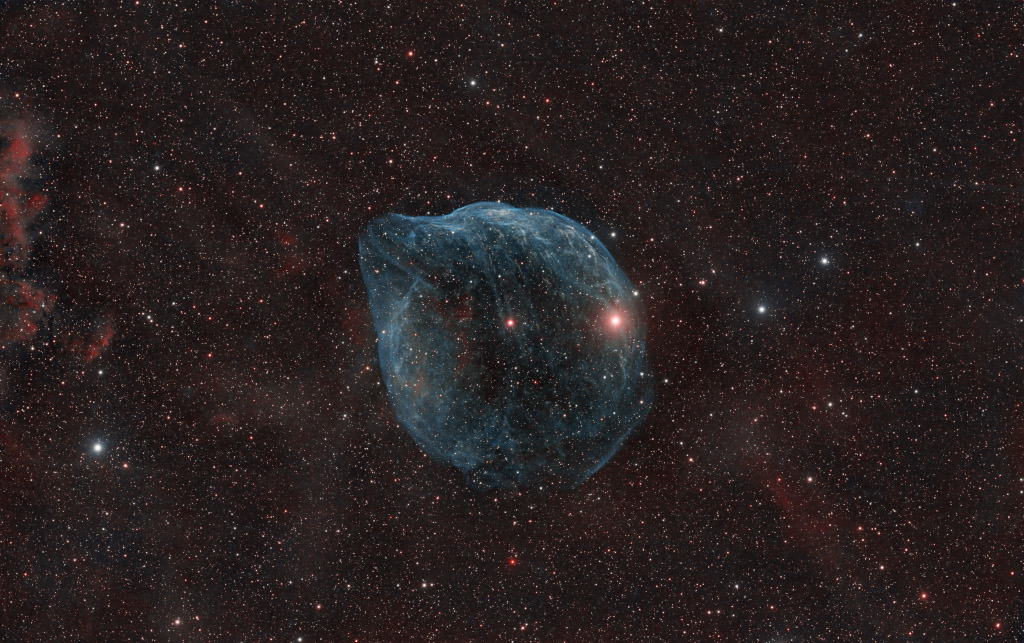
Blown by fast winds from a hot, massive star, this cosmic bubble is huge. Cataloged as Sharpless 2-308 it lies some 5,000 light-years away toward the well-trained constellation Canis Major and covers slightly more of the sky than a Full Moon. That corresponds to a diameter of 60 light-years at its estimated distance. The massive star that created the bubble, a Wolf-Rayet star, is the bright one near the center of the nebula. Wolf-Rayet stars have over 20 times the mass of the Sun and are thought to be in a brief, pre-supernova phase of massive star evolution. Fast winds from this Wolf-Rayet star create the bubble-shaped nebula as they sweep up slower moving material from an earlier phase of evolution. The windblown nebula has an age of about 70,000 years. Relatively faint emission captured by narrowband filters in the deep image is dominated by the glow of ionized oxygen atoms mapped to a blue hue. Presenting a mostly harmless outline, SH2-308 is also known as The Dolphin-head Nebula.

2024-06-07

Auteur/autrice

pelerinmarc@gmail.com

Publications similaires

Dans

Three Sky Arches over Snowy Alps

Pourquoi y a-t-il trois arches dans le ciel au lieu de deux ? Le mois dernier, après avoir été déposé par hélicoptère...

Lire la suite
Dans

Comet R3 PanSTARRS over a Himalayan Valley

La meilleure façon d’observer la longue queue de la comète R3 PanSTARRS est avec un appareil photo. Cette semaine, la comète récemment...

Lire la suite
Dans

Eye on the Milky Way

Avez-vous déjà eu des étoiles dans les yeux ? Il semble que l’œil de gauche en ait, et de plus, il semble...

Lire la suite
Dans

PanSTARRS and Planets

Près de l’horizon est avant le lever du soleil, la comète C/2025 R3 PanSTARRS devient plus brillante. Facilement visible aux jumelles et...

Lire la suite
Dans

M82: Starburst Galaxy with a Superwind

M82 est une galaxie à sursaut de formation d’étoiles, dotée d’un « supervent ». En effet, par le biais d’explosions de supernovae et de...

Lire la suite
Dans

South Celestial Tree

Si vous vivez dans l’hémisphère nord, vous avez peut-être appris à repérer l’étoile Polaire, Polaris, dans le ciel nocturne. Elle peut être...

Lire la suite