×
Dans

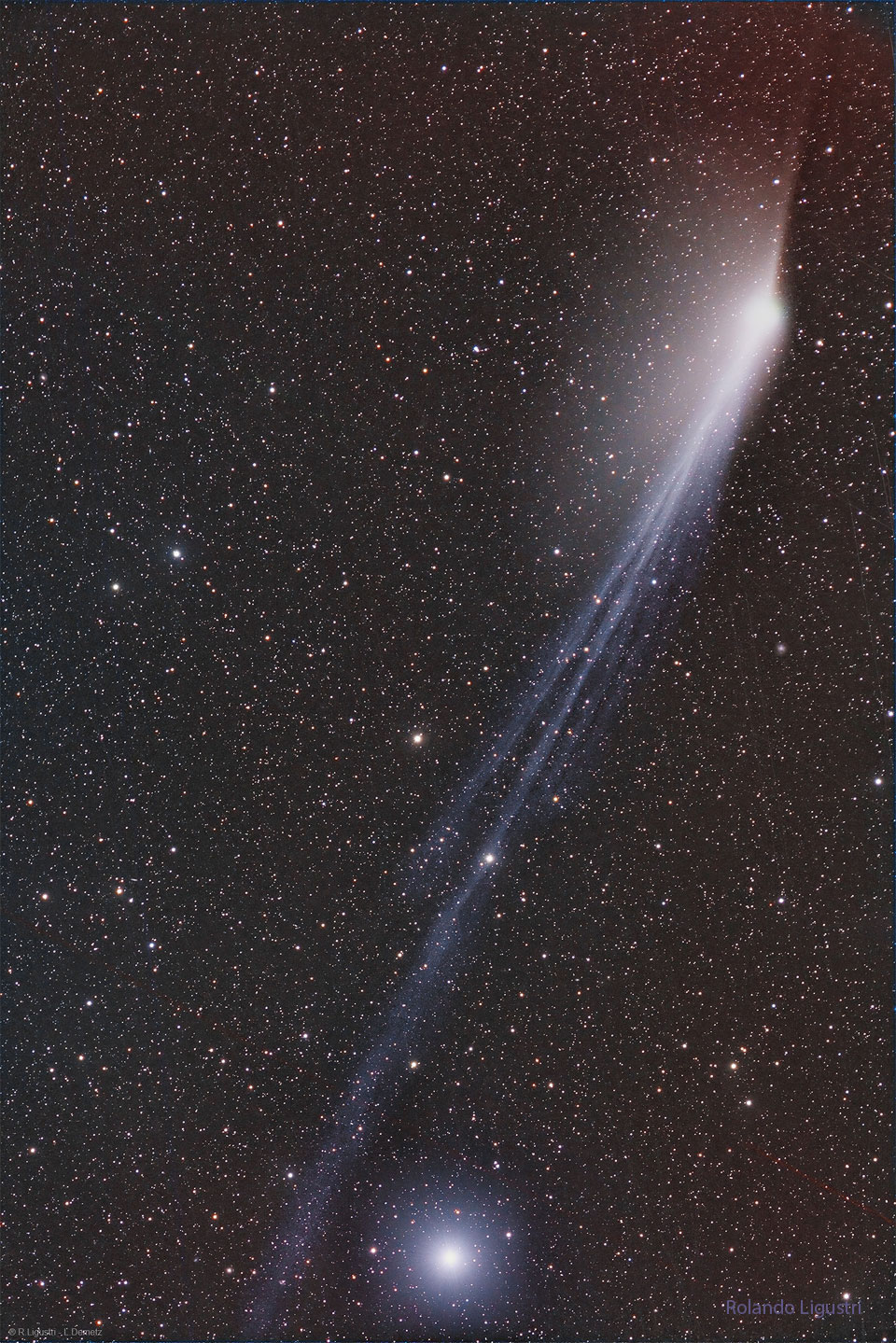
Why does Comet Pons-Brooks now have tails pointing in opposite directions? The most spectacular tail is the blue-glowing ion tail that is visible flowing down the image. The ion tail is pushed directly out from the Sun by the solar wind. On the upper right is the glowing central coma of Comet 12P/Pons–Brooks. Fanning out from the coma, mostly to the left, is the comet’s dust tail. Pushed out and slowed down by the pressure of sunlight, the dust tail tends to trail the comet along its orbit and, from some viewing angles, can appear opposite to the ion tail. The distant, bright star Alpha Leporis is seen at the bottom of the featured image captured last week from Namibia. Two days ago, the comet passed its closest to the Earth and is now best visible from southern skies as it dims and glides back to the outer Solar System.

2024-06-04

Auteur/autrice

pelerinmarc@gmail.com

Publications similaires

Dans

NGC 1566: The Spanish Dancer Galaxy

Sinon parfaite, cette galaxie spirale est au moins l’une des plus photogéniques. Univers îlot contenant des milliards d’étoiles et situé à environ...

Lire la suite
Dans

Equinox at the Pyramid of the Feathered Serpent

Pour voir le serpent à plumes descendre la pyramide maya, il faut un timing parfait. Vous devez visiter El Castillo — dans...

Lire la suite
Dans

A Year for K2-315b

Envie de visiter une planète qui a 3,14 jours dans une année ? Alors prévoyez un voyage vers K2-315b, une planète de...

Lire la suite
Dans

Toolondo Totality Trails

Dans ce paysage nocturne composite, des expositions empilées tracent de gracieux traînées d’étoiles au-dessus du lac Toolondo, Victoria, Australie, planète Terre. Capturées...

Lire la suite
Dans

CG 4: The Globule and the Galaxy

S’agit-il d’un monstre cosmique prêt à dévorer une galaxie inconsciente ? Heureusement, ce n’est pas le cas. Le « monstre » rouge montré dans...

Lire la suite
Dans

Sky Glows over Paranal Observatory

Non, les lasers de télescopes géants ne sont pas utilisés pour défendre la Terre. Les lasers tirés par les télescopes sont aujourd’hui...

Lire la suite