×
Dans

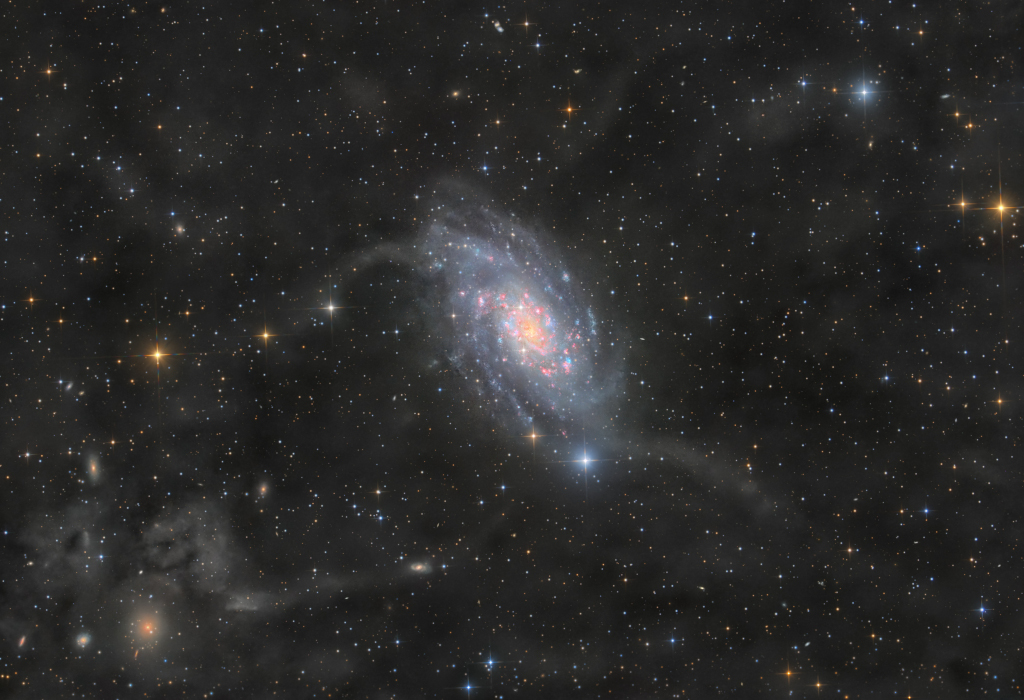
Magnificent island universe NGC 2403 stands within the boundaries of the long-necked constellation Camelopardalis. Some 10 million light-years distant and about 50,000 light-years across, the spiral galaxy also seems to have more than its fair share of giant star forming HII regions, marked by the telltale reddish glow of atomic hydrogen gas. The giant HII regions are energized by clusters of hot, massive stars that explode as bright supernovae at the end of their short and furious lives. A member of the M81 group of galaxies, NGC 2403 closely resembles a galaxy in our own local galaxy group with an abundance of star forming regions, M33, the Triangulum Galaxy. Spiky in appearance, bright stars in this portrait of NGC 2403 are in the foreground, within our own Milky Way. Also in the foreground of the deep, wide-field, telescopic image are the Milky Way’s dim and dusty interstellar clouds also known as galactic cirrus or integrated flux nebulae. But faint features that seem to extend from NGC 2403 itself are likely tidal stellar streams drawn out by gravitational interactions with neighboring galaxies.

2024-06-03

Auteur/autrice

pelerinmarc@gmail.com

Publications similaires

Dans

Plato and the Lunar Alps

Le cratère Plato, au sol sombre et large de 95 kilomètres, et les pics ensoleillés des Alpes lunaires (Montes Alpes) sont mis...

Lire la suite
Dans

M51: The Whirlpool Galaxy

La galaxie du Tourbillon est une galaxie spirale classique. Située à seulement 30 millions d’années-lumière et s’étendant sur 60 000 années-lumière, M51,...

Lire la suite
Dans

Meteor Dust

Que se passe-t-il avec ce météore ? Il se débarrasse de ses couches externes en traversant l’atmosphère terrestre et en s’échauffant. Les...

Lire la suite
Dans

M104: The Sombrero Galaxy in Infrared

Cet anneau flottant a la taille d’une galaxie. En réalité, c’est une galaxie, ou du moins une partie : la photogénique galaxie...

Lire la suite
Dans

Jupiter with the Great Red Spot

Jupiter atteint son opposition de 2026 aujourd’hui, le 10 janvier. Cela place la planète la plus massive de notre système solaire à...

Lire la suite
Dans

Ice Halos by Moonlight and Sunlight

La Lune et le Soleil créent tous deux de magnifiques halos de glace dans le ciel de la planète Terre. En fait,...

Lire la suite