×
Dans

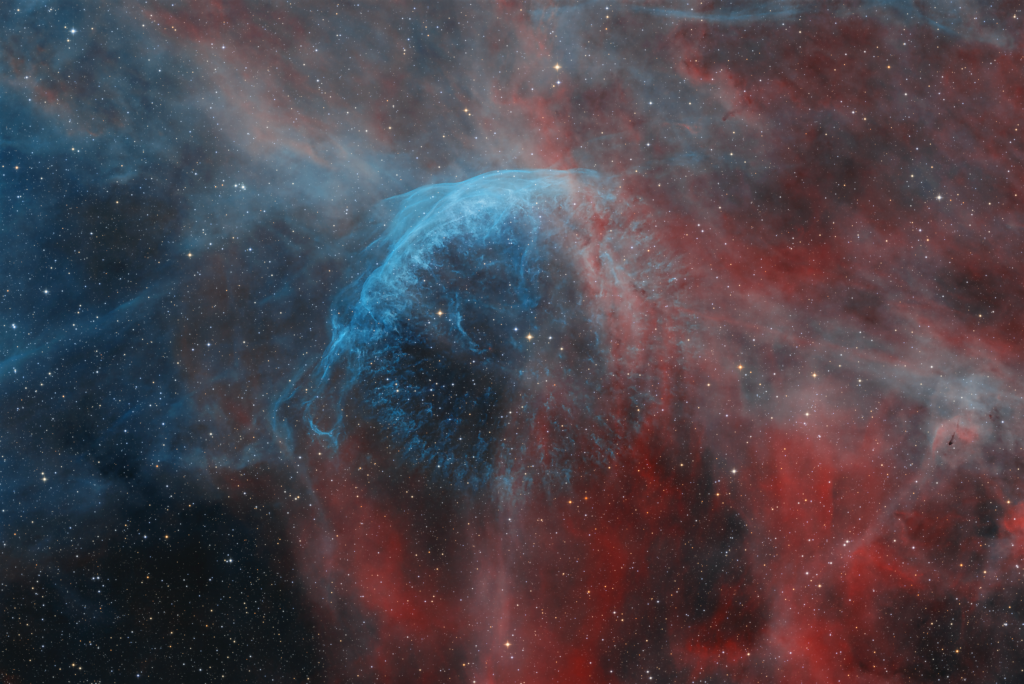
Made with narrowband filters, this cosmic snapshot covers a field of view over twice as wide as the full Moon within the boundaries of the constellation Cygnus. It highlights the bright edge of a ring-like nebula traced by the glow of ionized hydrogen and oxygen gas. Embedded in the region’s expanse of interstellar clouds, the complex, glowing arcs are sections of shells of material swept up by the wind from Wolf-Rayet star WR 134, brightest star near the center of the frame. Distance estimates put WR 134 about 6,000 light-years away, making the frame over 100 light-years across. Shedding their outer envelopes in powerful stellar winds, massive Wolf-Rayet stars have burned through their nuclear fuel at a prodigious rate and end this final phase of massive star evolution in a spectacular supernova explosion. The stellar winds and final supernova enrich the interstellar material with heavy elements to be incorporated in future generations of stars.

2024-05-31

Auteur/autrice

pelerinmarc@gmail.com

Publications similaires

Dans

NGC 188: Old Cluster in the New General Catalogue

Le New General Catalogue of star clusters and nebulae n’est en réalité pas si nouveau. Il a été publié en 1888, fruit...

Lire la suite
Dans

NGC 188: Old Cluster in the New General Catalogue

Le « New General Catalog of Star Clusters and Nebulae » n’est en réalité pas si nouveau. Il a été publié en 1888, un...

Lire la suite
Dans

The Conjunction of Comet R3 PanSTARRS and the Orion Nebula

L’image composite d’aujourd’hui présente quelque chose de vieux, quelque chose de neuf, quelque chose d’emprunté et quelque chose de bleu ! La...

Lire la suite
Dans

Moon Setting Behind Teide Volcano

Ces personnes ne sont pas en danger. Ce qui descend de la gauche n’est que la Lune, très loin à l’horizon. La...

Lire la suite
Dans

Comet R3 PanSTARRS and Orion

Orion n’avait jamais eu une épée pareille. Alors que la comète C/2025 R3 (PanSTARRS) quitte le système solaire interne, elle offre un...

Lire la suite
Dans

Messier Craters in Stereo

De nombreuses nébuleuses brillantes et amas d’étoiles dans le ciel de la Terre sont associés au nom de l’astronome Charles Messier, d’après...

Lire la suite