×
Dans

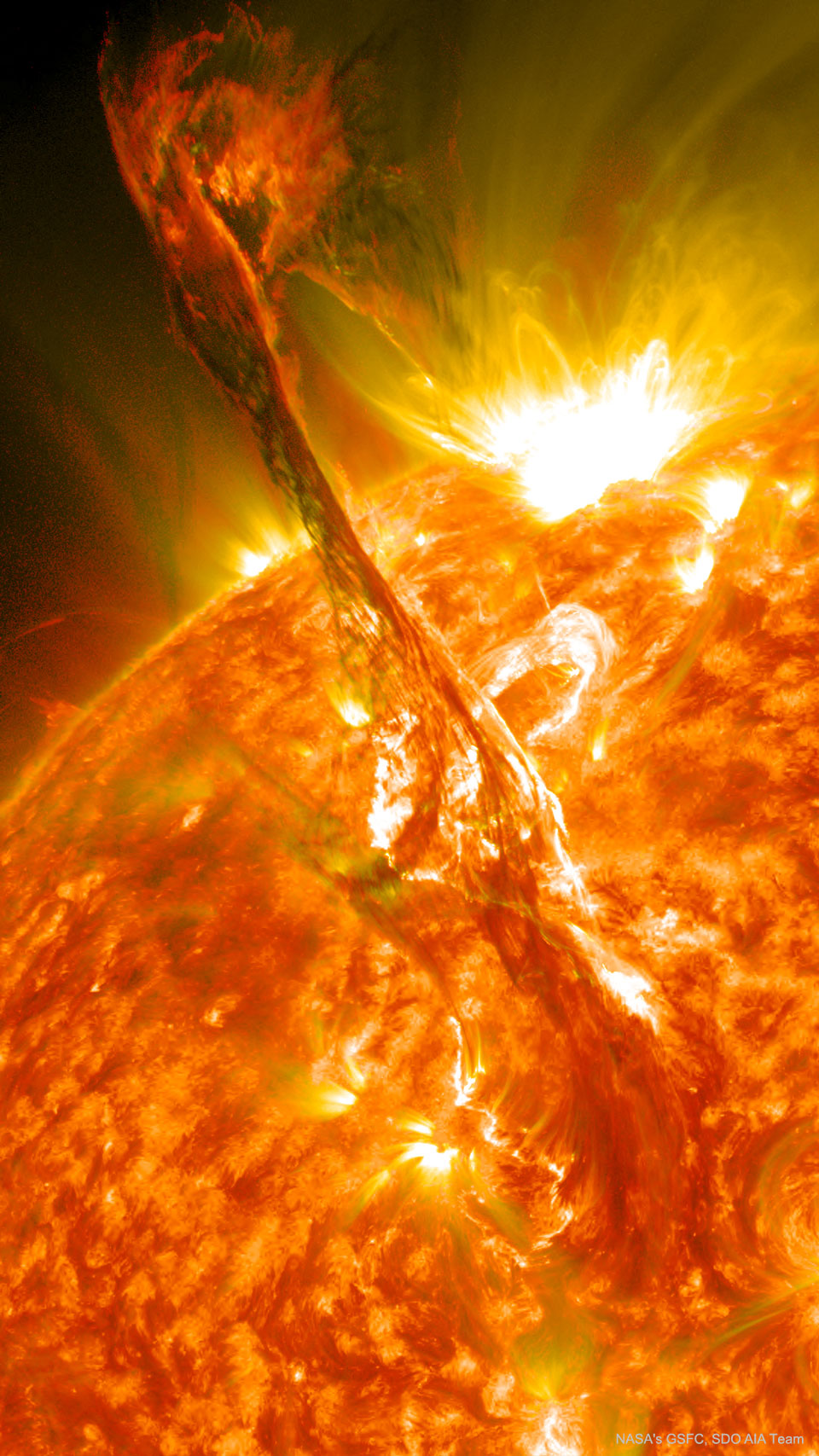
What’s happened to our Sun? Nothing very unusual — it just threw a filament. Toward the middle of 2012, a long standing solar filament suddenly erupted into space, producing an energetic coronal mass ejection (CME). The filament had been held up for days by the Sun’s ever changing magnetic field and the timing of the eruption was unexpected. Watched closely by the Sun-orbiting Solar Dynamics Observatory, the resulting explosion shot electrons and ions into the Solar System, some of which arrived at Earth three days later and impacted Earth’s magnetosphere, causing visible auroras. Loops of plasma surrounding the active region can be seen above the erupting filament in the featured ultraviolet image. Our Sun is nearing the most active time in its 11-year cycle, creating many coronal holes that allow for the ejection of charged particles into space. As before, these charged particles can create auroras. Your Sky Surprise: What picture did APOD feature on your birthday? (post 1995)

2024-05-26

Auteur/autrice

pelerinmarc@gmail.com

Publications similaires

Dans

Apollo 17 at Shorty Crater

Il y a cinquante-trois ans, en décembre 1972, les astronautes d’Apollo 17, Eugene Cernan et Harrison Schmitt, ont passé environ 75 heures...

Lire la suite
Dans

The Bipolar Jets of KX Andromedae

Jaillissant de l’étoile variable KX Andromède, ces stupéfiants jets bipolaires s’étendent sur 19 années-lumière. Récemment découverts, ils sont révélés avec un niveau...

Lire la suite
Dans

Galaxies in the Furnace

La galaxie elliptique géante NGC 1316, un exemple de violence à l’échelle cosmique, se situe à environ 75 millions d’années-lumière de nous,...

Lire la suite
Dans

Visualization: Near a Black Hole and Disk

À quoi ressemblerait une plongée dans un trou noir monstrueux ? Cette image issue d’une visualisation par superordinateur montre l’ensemble du ciel...

Lire la suite
Dans

M77: Spiral Galaxy with an Active Center

Que se passe-t-il au centre de la galaxie spirale voisine M77 ? Cette galaxie vue de face se trouve à seulement 47...

Lire la suite
Dans

3I ATLAS: Tails of an Interstellar Comet

Quelle est la typicalité de notre Système solaire ? L’étude de 3I/ATLAS, une comète de passage, fournit des indices. Les précédents visiteurs...

Lire la suite