×
Dans

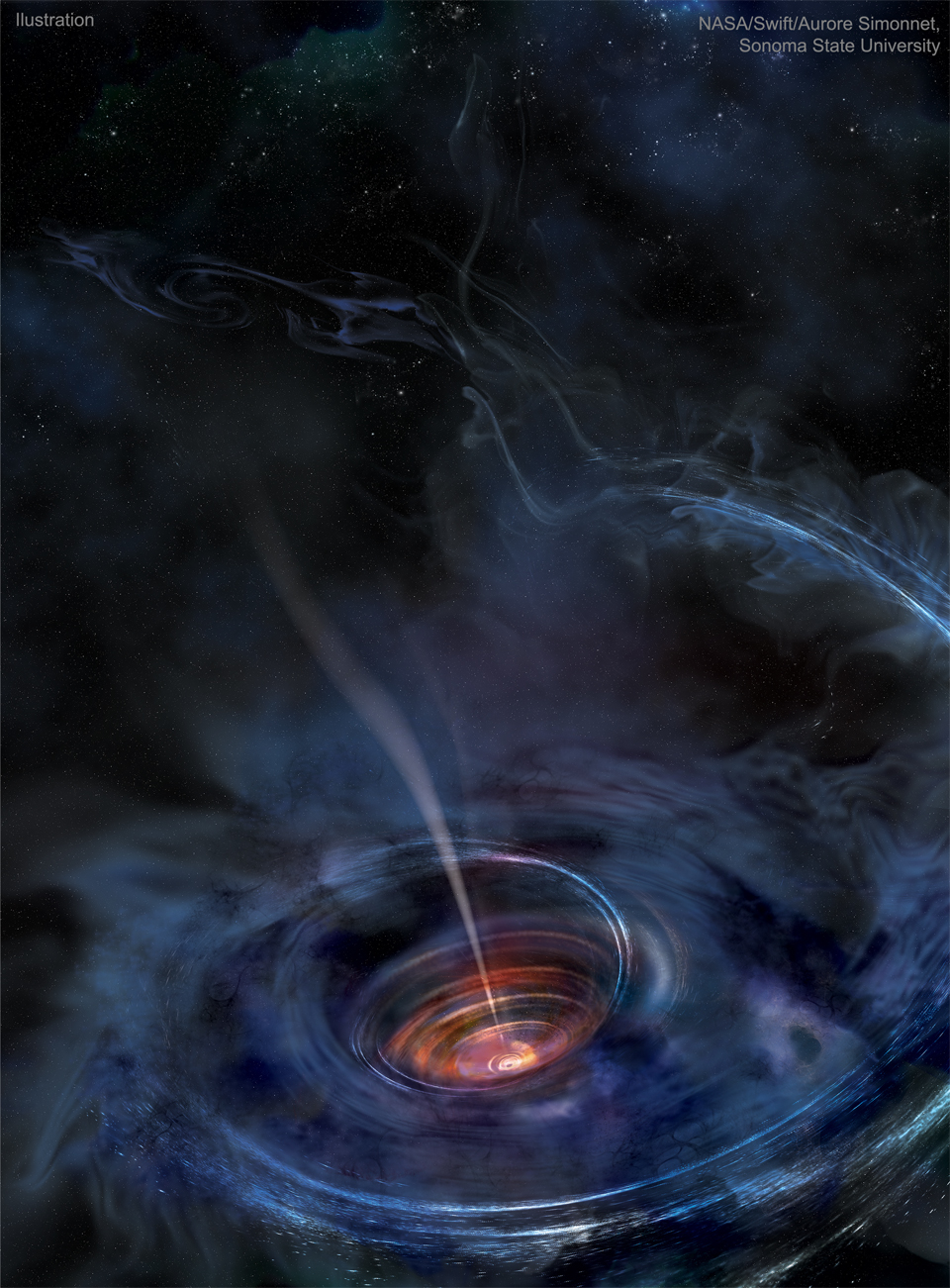
What happens when a black hole devours a star? Many details remain unknown, but observations are providing new clues. In 2014, a powerful explosion was recorded by the ground-based robotic telescopes of the All Sky Automated Survey for SuperNovae (Project ASAS-SN), with followed-up observations by instruments including NASA’s Earth-orbiting Swift satellite. Computer modeling of these emissions fit a star being ripped apart by a distant supermassive black hole. The results of such a collision are portrayed in the featured artistic illustration. The black hole itself is a depicted as a tiny black dot in the center. As matter falls toward the hole, it collides with other matter and heats up. Surrounding the black hole is an accretion disk of hot matter that used to be the star, with a jet emanating from the black hole’s spin axis. Fall towards eternity: It’s Black Hole Week at NASA!

2024-05-07

Auteur/autrice

pelerinmarc@gmail.com

Publications similaires

Dans

Orion and the Ocean of Storms

Le 5 décembre 2022, une caméra à bord du vaisseau spatial Orion sans équipage a capturé cette vue alors qu’Orion approchait de...

Lire la suite
Dans

Northern Fox Fires

Dans un mythe finlandais, lorsqu’un renard arctique court si vite que sa queue touffue effleure les montagnes, des étincelles enflammées sont projetées...

Lire la suite
Dans

Galaxies in the River

Les grandes galaxies grandissent en dévorant les plus petites. Même notre propre galaxie se livre à une sorte de cannibalisme galactique, absorbant...

Lire la suite
Dans

The Horsehead Nebula

Sculpté par les vents stellaires et le rayonnement, ce nuage moléculaire interstellaire poussiéreux a pris, par hasard, une forme immédiatement reconnaissable. Judicieusement...

Lire la suite
Dans

The Heart of the Soul Nebula

Ce gros plan cosmique plonge au cœur de la Nébuleuse de l’Âme. Les nuages de poussière sombres et menaçants, délimités par des...

Lire la suite
Dans

Apollo 17 at Shorty Crater

Il y a cinquante-trois ans, en décembre 1972, les astronautes d’Apollo 17, Eugene Cernan et Harrison Schmitt, ont passé environ 75 heures...

Lire la suite