×
Dans

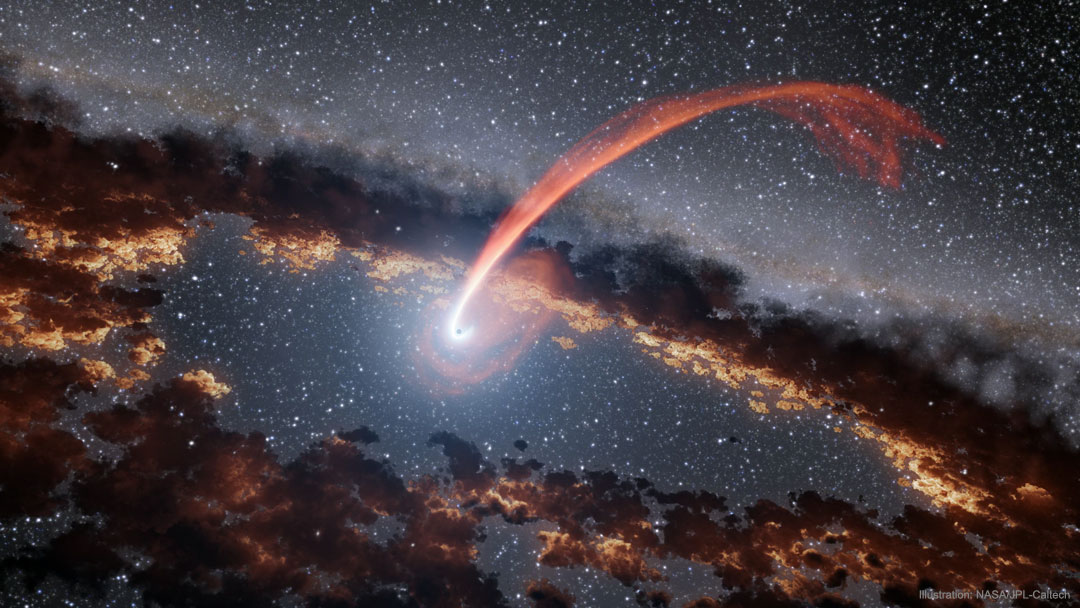
What happens to a star that goes near a black hole? If the star directly impacts a massive black hole, then the star falls in completely — and everything vanishes. More likely, though, the star goes close enough to have the black hole’s gravity pull away its outer layers, or disrupt, the star. Then, most of the star’s gas does not fall into the black hole. These stellar tidal disruption events can be as bright as a supernova, and an increasing amount of them are being discovered by automated sky surveys. In the featured artist’s illustration, a star has just passed a massive black hole and sheds gas that continues to orbit. The inner edge of a disk of gas and dust surrounding the black hole is heated by the disruption event and may glow long after the star is gone. Hole New Worlds: It’s Black Hole Week at NASA!

2024-05-05

Auteur/autrice

pelerinmarc@gmail.com

Publications similaires

Dans

Moon Setting Behind Teide Volcano

Ces personnes ne sont pas en danger. Ce qui descend de la gauche n’est que la Lune, très loin à l’horizon. La...

Lire la suite
Dans

Comet R3 PanSTARRS and Orion

Orion n’avait jamais eu une épée pareille. Alors que la comète C/2025 R3 (PanSTARRS) quitte le système solaire interne, elle offre un...

Lire la suite
Dans

Messier Craters in Stereo

De nombreuses nébuleuses brillantes et amas d’étoiles dans le ciel de la Terre sont associés au nom de l’astronome Charles Messier, d’après...

Lire la suite
Dans

Comet R3 PanSTARRS Before Rigel

Dans quelle direction va la comète R3 PanSTARRS ? Pas vers l’étoile en haut de l’image, car il s’agit de Rigel, qui,...

Lire la suite
Dans

The Retrograde Dance of Saturn and Neptune

Que signifie la rétrogradation de Saturne et Neptune ? La photo est un assemblage d’images prises sur 34 nuits entre mai 2025...

Lire la suite
Dans

Orion over Mount Teide

Orion est rarement visible ainsi. Pour obtenir cette majestueuse perspective, il faut un appareil photo capable de réaliser des expositions de si...

Lire la suite