×
Dans

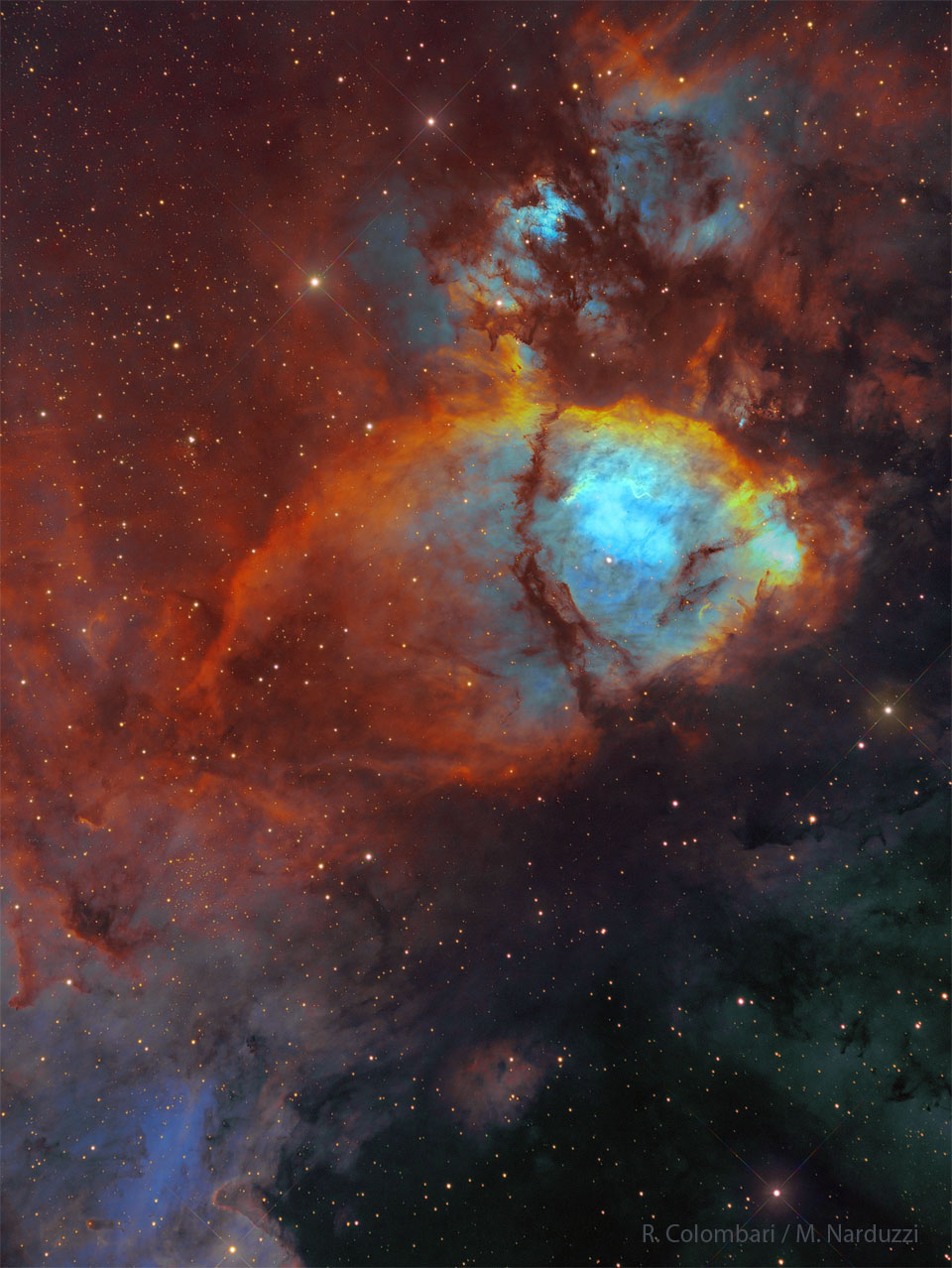
To some, this nebula looks like the head of a fish. However, this colorful cosmic portrait really features glowing gas and obscuring dust clouds in IC 1795, a star forming region in the northern constellation Cassiopeia. The nebula’s colors were created by adopting the Hubble color palette for mapping narrowband emissions from oxygen, hydrogen, and sulfur atoms to blue, green and red colors, and further blending the data with images of the region recorded through broadband filters. Not far on the sky from the famous Double Star Cluster in Perseus, IC 1795 is itself located next to IC 1805, the Heart Nebula, as part of a complex of star forming regions that lie at the edge of a large molecular cloud. Located just over 6,000 light-years away, the larger star forming complex sprawls along the Perseus spiral arm of our Milky Way Galaxy. At that distance, IC 1795 would span about 70 light-years across. Open Science: Browse 3,300+ codes in the Astrophysics Source Code Library

2024-05-01

Auteur/autrice

pelerinmarc@gmail.com

Publications similaires

Dans

Three Sky Arches over Snowy Alps

Pourquoi y a-t-il trois arches dans le ciel au lieu de deux ? Le mois dernier, après avoir été déposé par hélicoptère...

Lire la suite
Dans

Comet R3 PanSTARRS over a Himalayan Valley

La meilleure façon d’observer la longue queue de la comète R3 PanSTARRS est avec un appareil photo. Cette semaine, la comète récemment...

Lire la suite
Dans

Eye on the Milky Way

Avez-vous déjà eu des étoiles dans les yeux ? Il semble que l’œil de gauche en ait, et de plus, il semble...

Lire la suite
Dans

PanSTARRS and Planets

Près de l’horizon est avant le lever du soleil, la comète C/2025 R3 PanSTARRS devient plus brillante. Facilement visible aux jumelles et...

Lire la suite
Dans

M82: Starburst Galaxy with a Superwind

M82 est une galaxie à sursaut de formation d’étoiles, dotée d’un « supervent ». En effet, par le biais d’explosions de supernovae et de...

Lire la suite
Dans

South Celestial Tree

Si vous vivez dans l’hémisphère nord, vous avez peut-être appris à repérer l’étoile Polaire, Polaris, dans le ciel nocturne. Elle peut être...

Lire la suite