×
Dans

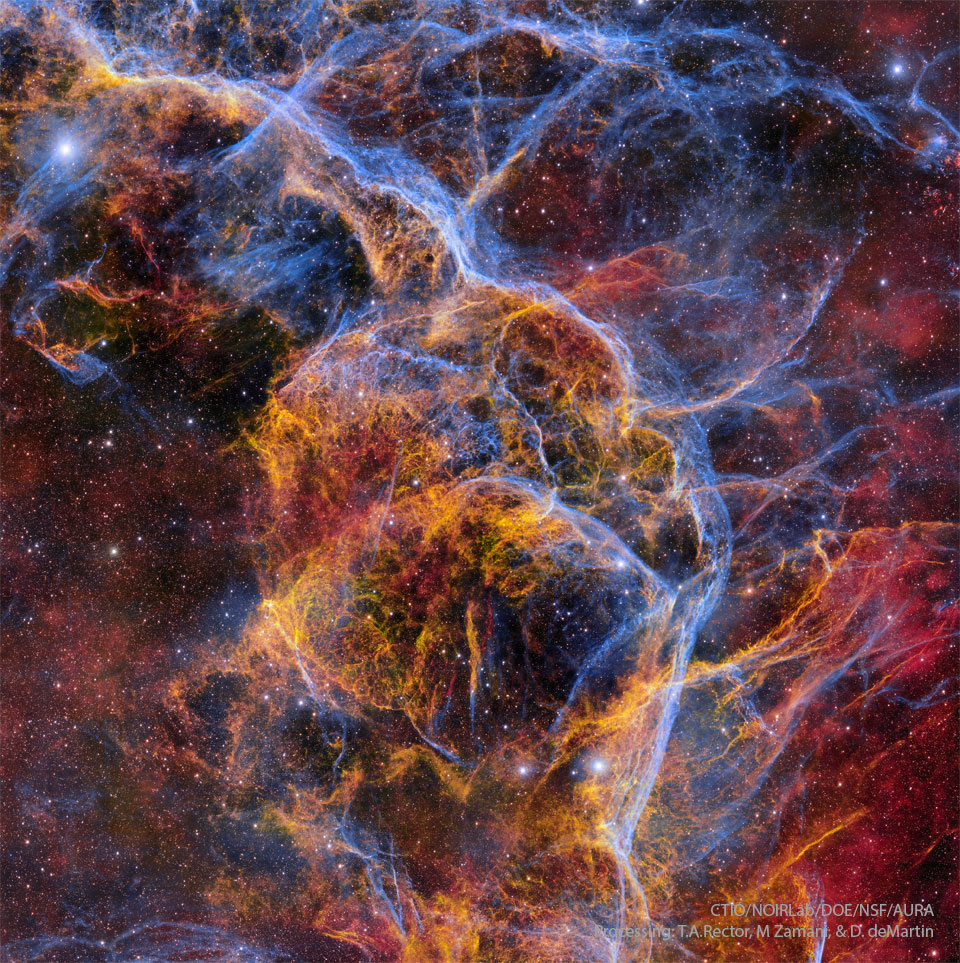
The explosion is over, but the consequences continue. About eleven thousand years ago, a star in the constellation of Vela could be seen to explode, creating a strange point of light briefly visible to humans living near the beginning of recorded history. The outer layers of the star crashed into the interstellar medium, driving a shock wave that is still visible today. The featured image captures some of that filamentary and gigantic shock in visible light. As gas flies away from the detonated star, it decays and reacts with the interstellar medium, producing light in many different colors and energy bands. Remaining at the center of the Vela Supernova Remnant is a pulsar, a star as dense as nuclear matter that spins around more than ten times in a single second. Monday’s Eclipse Imagery: Notable Submissions to APOD

2024-04-16

Auteur/autrice

pelerinmarc@gmail.com

Publications similaires

Dans

The Claw and Bubble Nebulae

Quelles choses inattendues voyez-vous lorsque vous levez les yeux vers le ciel nocturne ? L’image d’aujourd’hui ressemble à une peinture abstraite, avec...

Lire la suite
Dans

Uranus’s Largest Moon: Titania

Le terrain tourmenté de Titania est un mélange de canyons, de falaises et de cratères. La sonde interplanétaire Voyager 2 de la...

Lire la suite
Dans

Peculiar Elliptical Galaxy Centaurus A

Qu’est-il arrivé au centre de cette galaxie ? D’impressionnantes bandes de poussière traversent le centre de l’étrange galaxie elliptique Centaurus A. Ces...

Lire la suite
Dans

A Message from Earth

Qu’essaient de nous dire ces Terriens ? Le message mis en avant a été diffusé depuis la Terre vers l’amas globulaire M13...

Lire la suite
Dans

Robert Goddard and Nell

Robert H. Goddard, considéré comme le père de la fuséologie moderne, est né à Worcester, Massachusetts, en 1882. À 16 ans, Goddard...

Lire la suite
Dans

Hickson 44 in Leo

En scrutant le ciel à la recherche de galaxies, l’astronome canadien Paul Hickson et ses collègues ont identifié environ 100 groupes de...

Lire la suite