×
Dans

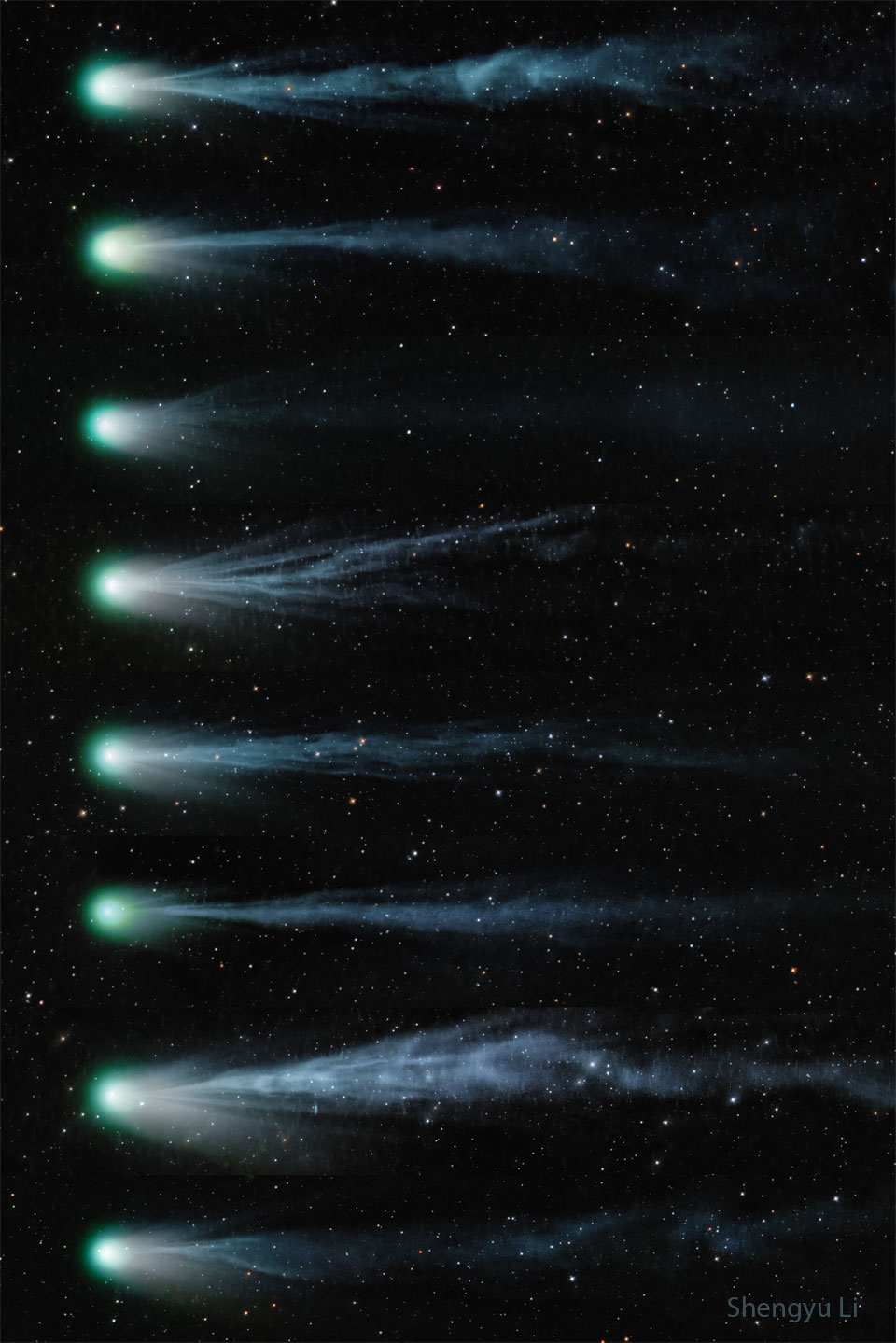
How does a comet tail change? It depends on the comet. The ion tail of Comet 12P/Pons–Brooks has been changing markedly, as detailed in the featured image sequenced over nine days from March 6 to 14 (top to bottom). On some days, the comet’s ion tail was relatively long and complex, but not every day. Reasons for tail changes include the rate of ejection of material from the comet’s nucleus, the strength and complexity of the passing solar wind, and the rotation rate of the comet. Over the course of a week, apparent changes even include a change of perspective from the Earth. In general, a comet’s ion tail will point away from the Sun, as gas expelled is pushed out by the Sun’s wind. Today, Pons-Brooks may become a rare comet suddenly visible in the middle of the day for those able to see the Sun totally eclipsed by the Moon. NASA Coverage: Today’s Total Solar Eclipse Total Eclipse Imagery: Notable Submissions to APOD

2024-04-08

Auteur/autrice

pelerinmarc@gmail.com

Publications similaires

Dans

Three Galaxy Pairs

Chacune de ces paires de galaxies est différente. Les deux galaxies du haut n’interagissent probablement pas, du moins pas actuellement. Cependant, la...

Lire la suite
Dans

Contemplating the Sun

Avez-vous contemplé votre étoile natale récemment ? Présenté ici, un Soleil partiellement éclipsé en haut à gauche par la Lune est également...

Lire la suite
Dans

A Messier Moment for Tempel 2

Lequel de ceux-ci n’est pas une comète ? Vous l’avez deviné – celui de droite est un amas globulaire d’étoiles. La coma...

Lire la suite
Dans

Rubin’s COSMOS field

Plus d’un demi-million de galaxies peuplent le panneau central de cette image provenant de l’Observatoire Vera C. Rubin de la NSF-DOE au...

Lire la suite
Dans

New Sharpest Image of the Sun Uncovers Instability

L’image la plus nette de notre Soleil montre quoi ? L’instabilité. Pour être précis, un certain type de processus interactif appelé instabilité...

Lire la suite
Dans

Spokes on Saturn’s B Ring

Ne vous laissez pas effrayer par les rayons fantomatiques de Saturne ! Aujourd’hui, nous vous proposons un timelapse de près de deux...

Lire la suite