×
Dans

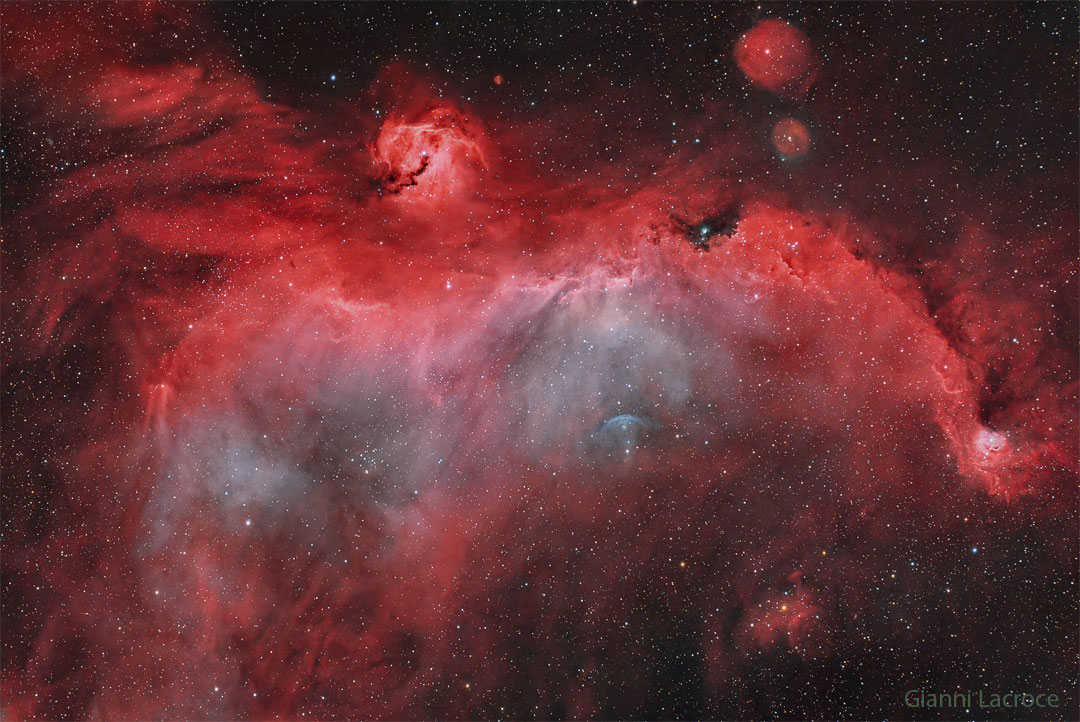
A broad expanse of glowing gas and dust presents a bird-like visage to astronomers from planet Earth, suggesting its popular moniker: the Seagull Nebula. This portrait of the cosmic bird covers a 1.6-degree wide swath across the plane of the Milky Way, near the direction of Sirius, the alpha star of the constellation of the Big Dog (Canis Major). Of course, the region includes objects with other catalog designations: notably NGC 2327, a compact, dusty emission and reflection nebula with an embedded massive star that forms the bird’s head. Dominated by the reddish glow of atomic hydrogen, the complex of gas and dust clouds with bright young stars spans over 100 light-years at an estimated 3,800 light-year distance. Almost Hyperspace: Random APOD Generator

2024-03-13

Auteur/autrice

pelerinmarc@gmail.com

Publications similaires

Dans

Pathfinder on Mars

Le 4 juillet 1997, en utilisant son propre ensemble de feux d’artifice, un parachute et un cocon d’airbags, le vaisseau spatial Mars...

Lire la suite
Dans

Three Galaxies in Pavo

À environ 190 millions d’années-lumière, bien au-delà des étoiles brillantes et des nébuleuses de la Voie lactée, ces trois galaxies sont attirées...

Lire la suite
Dans

Sibling Supernova Remnants

Que se passe-t-il lorsqu’une des étoiles d’un système binaire explose en supernova ? Cette image combine la lumière visible (jaune), ultraviolette (violet)...

Lire la suite
Dans

The Cotton Candy Clouds of Rho Ophiuchi

Bien qu’elles ressemblent à de la barbe à papa, vous ne pouvez pas manger ces nuages ! Prise à Cadix, en Espagne,...

Lire la suite
Dans

Unusually Smooth Sections of Asteroid Itokawa

Pourquoi certaines parties de la surface de cet astéroïde sont-elles si lisses ? La réponse semble liée à la dynamique d’un astéroïde...

Lire la suite
Dans

M82: Galaxy with a Supergalactic Wind

Pourquoi la Galaxie du Cigare émet-elle de la fumée rouge ? M82, comme cette galaxie de formation d’étoiles est également connue, a...

Lire la suite